Jump to a section
Switching to an electric car cuts out oil changes, exhausts and most brake wear. Tyres are the one cost that tends to go the other way. Plenty of EV owners in the UK are surprised when a Tesla Model 3, Kia EV6 or VW ID.4 needs fresh rubber well before the 20,000 mile mark.
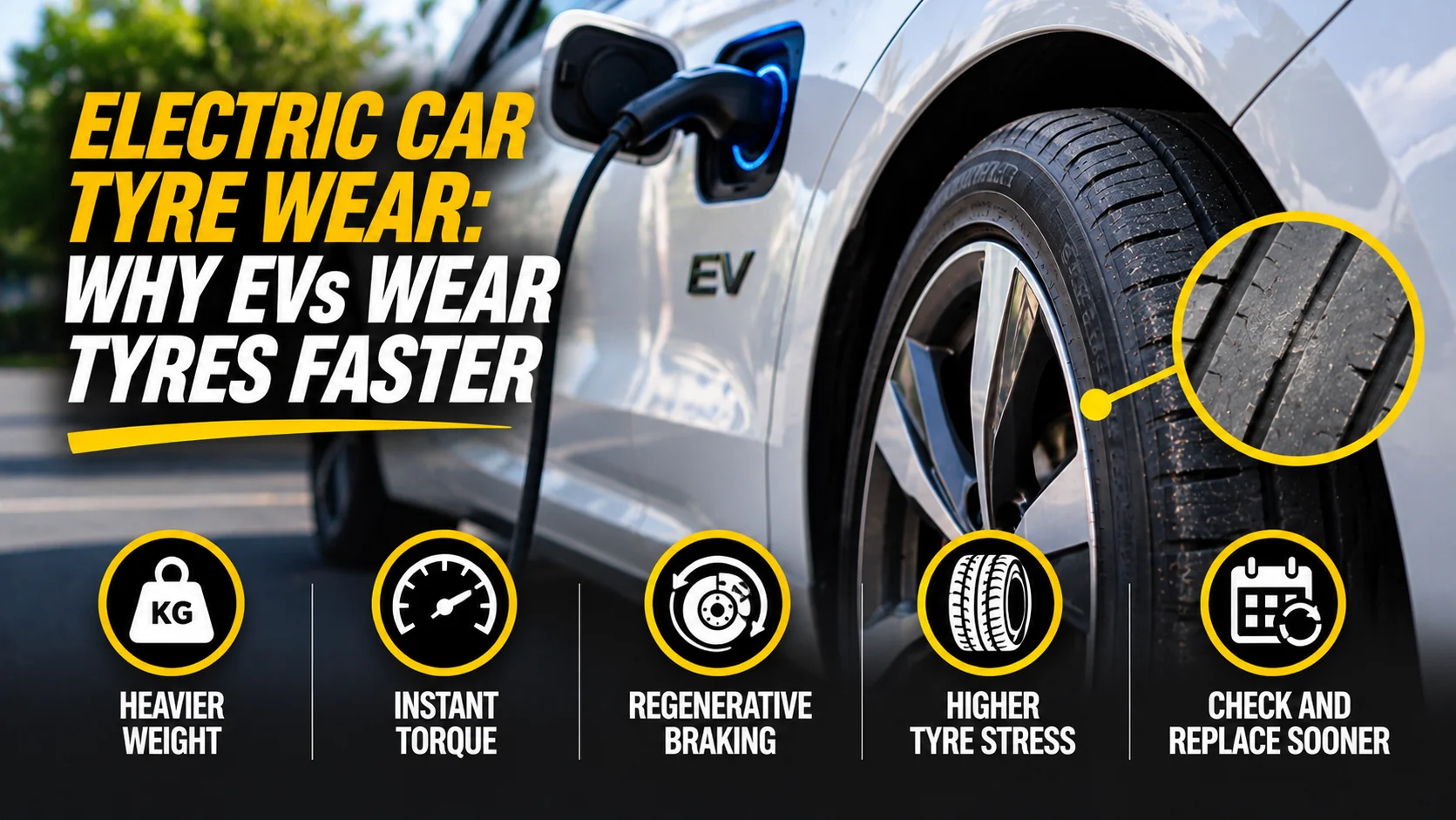
Quick answer: Yes, electric cars usually wear tyres faster than similar petrol or diesel cars. Michelin puts the figure at up to 20% faster. The main reasons are the extra weight of the battery pack, instant torque from the electric motor, regenerative braking through the driven wheels and, on many models, wide low-profile tyres. Correct tyre pressures, good wheel alignment, regular rotation and a smoother right foot cut most of that extra wear.
Key takeaways
- A typical family EV weighs around 2,000kg against roughly 1,400kg for a similar petrol car, and that load sits on four small contact patches.
- Rear-wheel-drive EVs show the biggest gap. Cap hpi data found they needed 5.9 tyres over 30,000 miles, against 3.7 for comparable petrol and diesel cars.
- When testers allowed for weight, most of the difference between an EV and an identical petrol model disappeared. Weight is the big driver, not the battery itself.
- EV-specific tyres (often marked HL or XL) are built to carry the load and resist wear, and they usually cost about the same as standard tyres in the same size.
Do Electric Cars Really Wear Tyres Faster? What the Data Shows
Short version: yes, but the size of the gap depends a lot on the car and the driver. Here is what the main studies and fleet data say.
| Source | What was measured | Finding |
|---|---|---|
| Michelin (via Autocar) | Manufacturer estimate | EVs can wear tyres up to 20% faster than petrol and diesel cars |
| Cap hpi (via What Car?) | Tyres replaced over 30,000 miles or 3 years | EVs averaged 5.3 tyres, ICE cars 3.6 |
| Science of the Total Environment, 2022 (via InsideEVs) | Tread lost per km on the same route | EV 201.7mg/km, petrol 158.9mg/km, diesel 167.4mg/km |
| Epyx fleet data, 2025 (via InsideEVs) | Mileage at first tyre replacement on company cars | EVs about 14,352 miles, combustion cars about 18,333 miles |
| IMI analysis of DfT MOT data | Share of MOT failures caused by tyres | 46% for EVs, 32% for petrol cars |
A word of caution on that Cap hpi “67% faster” headline you may have seen. It is a real figure, but fleet numbers mix in bigger, more powerful EVs and company drivers who are not paying for the tyres. The Epyx sample also leaned towards larger cars. So treat the 20% to 30% range as the realistic middle ground for a normal private driver, with performance EVs sitting higher.
Why EVs Wear Tyres Faster: The Main Causes
1. Battery weight
This is the big one. A battery pack can add several hundred kilograms to a car, and the tyres have to carry it every mile. More weight means more force pressing the tread into the road, more scrubbing in corners and more heat.
Testing for European car makers by UTAC backs this up. An electric BMW iX1 lost more rubber per km than five petrol X1s driven alongside it over 15,000km, but once the extra weight was accounted for, the difference largely went away. In plain terms, a heavy petrol SUV wears tyres the same way. EVs just tend to be heavier.
2. Instant torque
A petrol engine builds its pulling power as the revs rise. An electric motor gives you all of it the moment you press the pedal. That is why a Volvo EX30 can hit 62mph in about 3.6 seconds.
The catch is that every brisk getaway from traffic lights twists the tread blocks against the tarmac. You rarely hear a squeal, as traction control keeps things tidy, but the tyre still loses a tiny bit of rubber each time. Do that 30 times on a London commute and it adds up.
3. Regenerative braking
Regen braking slows the car by running the motor as a generator. Brilliant for range and for your brake pads (UK government research by Ricardo found it cut brake dust noticeably). But the slowing force goes through the driven wheels only, so those tyres now do the accelerating and most of the braking. Strong one-pedal settings put the most load on them.
4. Bigger wheels and grippy, low-resistance compounds
Many EVs come on 19 to 21 inch wheels with wide, low-profile tyres. The same Ricardo study found larger 18 inch tyres showed higher wear rates than smaller ones. Makers also fit low rolling resistance tyres to stretch range, and some of these use softer or thinner tread to save energy, which can mean less rubber to wear through.
5. Drive layout
This part rarely gets mentioned, but it shapes where the wear goes. Cap hpi’s numbers split by drivetrain tell the story:
| Drive type | EV tyres per 30,000 miles | Petrol/diesel tyres per 30,000 miles | Gap |
|---|---|---|---|
| Rear-wheel drive | 5.9 | 3.7 | 62% |
| Four-wheel drive | 5.4 | 3.6 | 51% |
| Front-wheel drive | 4.4 | 3.5 | 26% |
Rear-drive EVs such as the Tesla Model 3 RWD, Polestar 2 single motor (from 2024) and VW ID.3 put all the torque and regen through the back tyres. Our fitters regularly see rears down near the limit while the fronts still have plenty of life.
Where EV Tyres Wear First
Knowing the usual wear patterns helps you catch a problem early, before it costs you a full set.
| What you see | Likely cause | What to do |
|---|---|---|
| Rear tyres much lower than fronts | Rear-wheel drive, torque and regen | Rotate if your sizes allow it |
| Inner edge worn, outside looks fine | Alignment or camber settings, common on heavy EVs | Get the tracking checked |
| Both outer edges worn | Under-inflation | Set pressures to the door-pillar placard |
| Centre strip worn | Over-inflation | Lower to the correct pressure |
| Patchy, scalloped wear | Wheel balance or suspension issue | Balance check and inspection |
The inner edge one catches people out. You cannot see it with the wheel straight, and a tyre can look healthy from the kerb while the inside shoulder is down to the cords. Turn the steering to full lock when you check, or ask for a proper tyre inspection.
Do You Need EV-Specific Tyres?
You don’t legally have to fit them, but in most cases it makes sense. An EV tyre is built around the problems above rather than just carrying a badge.
- Load rating. Heavier EVs often need tyres with an HL (High Load) marking before the size, or XL (Extra Load) for the biggest electric SUVs. Fitting a tyre with too low a load index is unsafe, so always match or exceed what the car maker specifies. Our tyre markings guide explains how to read this on the sidewall.
- Tougher tread compounds. Michelin, Pirelli (Elect range) and Continental all claim their EV lines have largely closed the 20% wear gap.
- Low rolling resistance. Moving up one EU tyre label class for rolling resistance can add roughly 3% to 4% to your range, according to What Car?.
- Noise foam. Some tyres have a foam layer inside to cut road roar, which you notice more without an engine. Tesla’s own tyres often carry a “T0” marking and Porsche uses “N” codes, so check these OE marks before swapping brands.
On price, the good news is that Cap hpi found the cost gap between EV and standard tyres has narrowed to a few percent in the same size. If you are weighing up brands, our budget vs premium tyres guide covers the trade-offs, and it matters more on an EV because a cheap tyre wears out faster under the extra weight.
How to Make Your EV Tyres Last Longer
None of this needs special kit. It is mostly habit.
- Check pressures monthly, when cold. Use the figures on the driver’s door pillar, not a generic number. EVs often run higher pressures than you might expect. Our tyre pressure guide walks through it, and the dashboard TPMS warning is a backup, not a replacement for checking.
- Get the alignment checked once a year, and after any big pothole hit. On a 2-tonne car, slightly wrong tracking eats tyres fast. See wheel alignment vs tracking for the difference.
- Rotate every 5,000 to 6,000 miles if your front and rear tyres are the same size. Cars with staggered sizes (wider rears, as on some Tesla Performance and Porsche Taycan models) can’t be rotated front to back. More on that in is tyre rotation worth it.
- Use Eco or Comfort mode day to day. Most EVs soften throttle response in these modes, which takes the edge off that instant torque.
- Ease into regen. A medium regen setting and smooth lifts off the pedal are kinder to the driven tyres than snatching at one-pedal mode.
- Keep wheels balanced. An out-of-balance wheel causes patchy wear and vibration. Mobile wheel balancing is a quick fix.
- Don’t run to the legal limit. UK law says 1.6mm across the central three-quarters of the tread, but wet grip drops off well before that. Many experts suggest replacing at 3mm, and on a heavy EV that extra margin counts. Our tread depth guide shows how to measure it.
One call and a fitter comes to the car
Home, work, roadside or car park, anywhere in London and across the UK. Tyres on board and balancing done on site.
20 to 30 min ETA in LondonCars, vans and luxury vehiclesOpen 24/7, seven days
The Other Side of the Story
It would be unfair to paint EVs as tyre shredders. Driving style moves the needle more than most people think. A gentle driver in a Nissan Leaf will likely get more miles from a set than someone hammering a hot hatch. Tyre makers are also catching up quickly, and EV owners save on brake pads, discs and servicing, which offsets some of the extra tyre spend.
There is an environmental angle too. Emissions Analytics, a UK testing firm, estimates EVs produce about 20% more tyre wear particles because they are typically around 400kg heavier. Lighter cars and longer-lasting tyres help on both cost and air quality, which is one more reason to look after the set you have.
For a wider look at what shortens tyre life on any car, see how long should tyres last. And when your EV does need new rubber, mobile tyre fitting means the job can be done on your driveway or at work, with model-specific options such as Tesla tyre fitting covering OE-marked tyres and correct jacking points.
FAQs
How many miles do EV tyres last in the UK?
It varies widely by car, tyre and driving. Fleet data from Epyx put the first tyre change on electric company cars at about 14,350 miles on average, against about 18,300 for petrol and diesel cars. Private owners who drive smoothly and keep pressures right often do better than that.
Why do Tesla tyres wear out so fast?
Teslas are heavy, very quick off the line, and the Model 3 and Model Y in rear-drive form send all their power and regen through the rear tyres. Many also ship on large, low-profile wheels. Rear tyre wear and inner edge wear are the two patterns we see most.
Can I put normal tyres on an electric car?
Yes, as long as the size, load index and speed rating match or exceed the car maker’s spec. The load index is the one to watch, as many EVs need HL or XL rated tyres. A standard tyre with the right ratings is legal, though it may wear faster and be noisier than an EV-optimised one.
Do hybrid cars wear tyres faster too?
Usually less than a full EV. Hybrids carry a smaller battery, so the weight penalty is lower, though plug-in hybrids can be surprisingly heavy and sit somewhere in between.
Are EV tyres more expensive?
Not by much in the same size. Cap hpi found the price gap has narrowed to just a few percent. The bigger cost is that you may buy them more often, which is why the maintenance habits above pay for themselves.
Mobile Tyre Surgeons has over 15 years of hands-on tyre fitting experience across London and the UK, working on everything from family EVs to high-performance electric models.
One call and a fitter comes to the car
Home, work, roadside or car park, anywhere in London and across the UK. Tyres on board and balancing done on site.
20 to 30 min ETA in LondonCars, vans and luxury vehiclesOpen 24/7, seven days