
Jump to a section
- What the Sidewall Actually Does
- Why Sidewall Damage Can’t Be Repaired
- Types of Sidewall Damage and What Each One Means
- When Is Sidewall Damage Just Cosmetic?
- What UK Tyre Law and the MOT Say
- What Causes Sidewall Damage on UK Roads
- What to Do If You Find Sidewall Damage
- How to Lower the Risk
- Frequently Asked Questions
You’ve spotted a bubble, a cut or a nail in the side of your tyre, and the first question is whether it can be fixed or whether you’re buying a new tyre today. Here’s the straight answer, then the detail behind it.
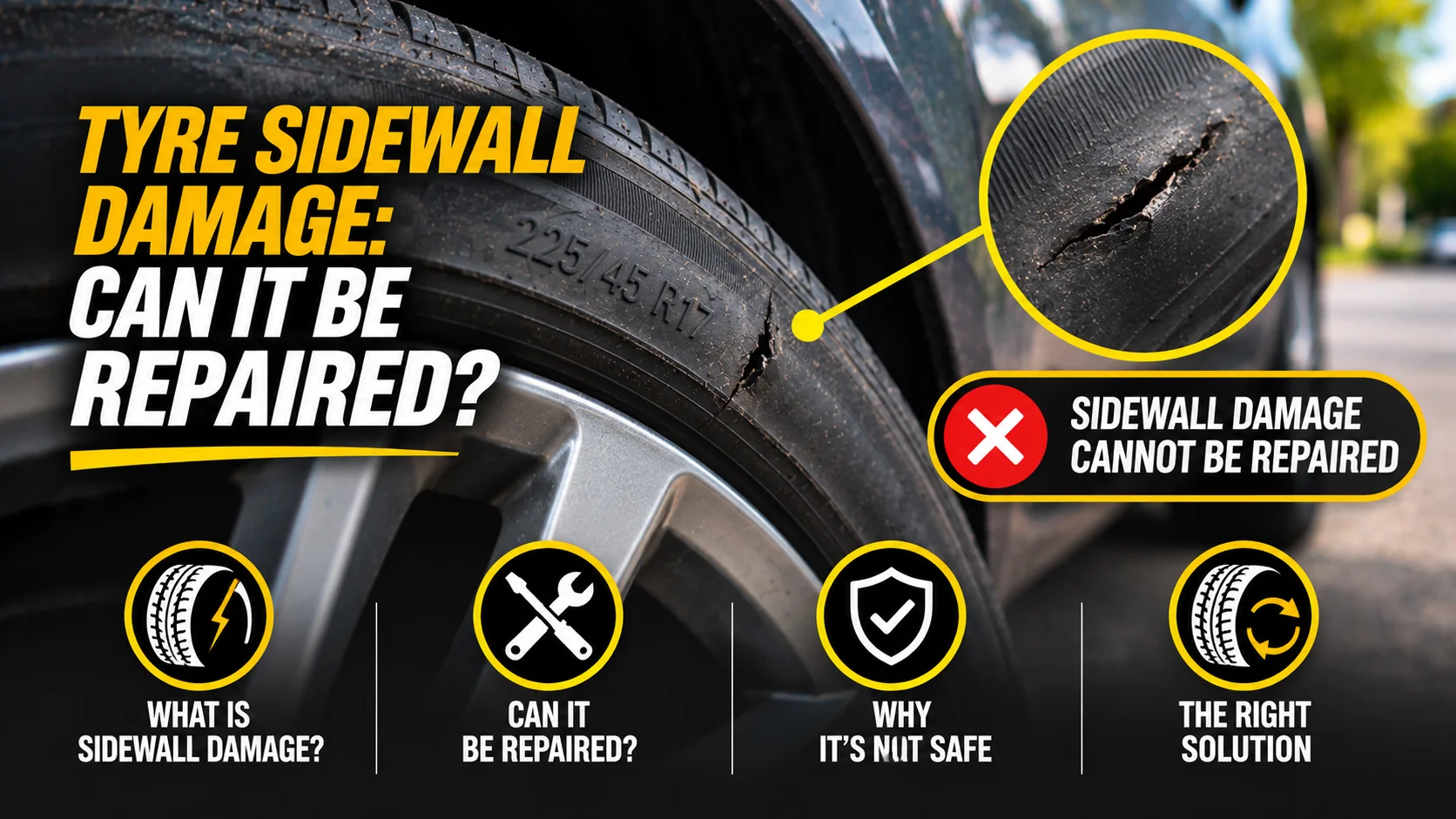
Short answer: No. Under the UK tyre repair standard, BS AU 159, only punctures in the central three quarters of the tread can be repaired. Any puncture, cut, bulge or tear in the sidewall (or the shoulder next to it) means the tyre has to be replaced. Light surface scuffs that don’t reach the cords are the only exception, and a trained tyre technician should confirm that.
Key takeaways
- Sidewall damage is never repairable in the UK, whatever the size of the hole.
- A sidewall bulge is classed as a Dangerous defect in the MOT and can fail instantly on the road.
- Driving on a damaged tyre can cost up to £2,500 and 3 penalty points per tyre.
- Potholes and kerbs cause most sidewall damage we see.
- If you find damage, swap to the spare or get the tyre replaced before your next journey.
What the Sidewall Actually Does
A tyre isn’t one solid lump of rubber. Under the outer layer sits the carcass, made from layers of fabric ply with fine cords running through them. On top of that you’ve got the tread (the bit touching the road), the shoulder (where tread turns into the side), the sidewall, and the bead, the steel-reinforced edge that locks the tyre onto the wheel rim.
The sidewall is the part that carries the weight of your car and soaks up bumps. It also flexes on every single rotation. At 70mph, that’s hundreds of flexes a minute, and the sidewall is thinner than the tread because it needs that flexibility.
That’s the whole problem in a sentence. The part of the tyre that moves the most is the part with the least rubber protecting the cords.
Why Sidewall Damage Can’t Be Repaired
In the UK, tyre repairs follow BS AU 159, the British Standard for repairing tyres used on public roads. It sets out where on a tyre a repair is allowed and how big the damage can be.
For car tyres, a standard puncture repair is only allowed in the minor repair area, which is the central ¾ of the tread, and the hole has to be 6mm or smaller. Anything outside that zone is off limits.
The reason is mechanical, not a rule for the sake of it. A plug-patch repair bonds to the inner liner and fills the hole. In the tread, where the steel belts keep things stiff, that bond holds. In the sidewall, the constant bending works the patch loose, and the cords around the damage keep weakening even if the air stays in for a while. A repair might look fine on the driveway and let go on the motorway.
| Damage location | Repairable? | Why |
|---|---|---|
| Central ¾ of tread (hole up to 6mm) | Usually yes | Stiff, belted area, inside the BS AU 159 minor repair zone |
| Outer tread edge / shoulder | No | Too close to the flexing zone |
| Sidewall | No | Constant flex, thin rubber, cords take the load |
| Bead area | No | Affects how the tyre seals and seats on the rim |
Our technicians follow the same rule on every job. If you’d like to see what a proper tread repair involves, we’ve broken it down in how mobile tyre fitters repair a puncture step by step.
Types of Sidewall Damage and What Each One Means
Not every mark on the sidewall looks dramatic. Some of the most dangerous damage is a small, harmless-looking bubble.
| What you see | What it usually means | Safe to drive? | Action |
|---|---|---|---|
| Bulge or bubble | Internal cords have snapped, air is pushing through to the outer rubber | No | Replace now, use the spare |
| Cut or gash | Rubber sliced, possibly down to the ply or cords | No, if cords are reached | Replace |
| Nail or screw in the side | Puncture through the casing | No | Replace (never plug) |
| Deep cracking (perishing) | Rubber has aged and hardened, often from UV and age | Get it checked | Usually replace |
| Light kerb scuff | Surface rubber scraped, cords untouched | Often yes | Have it inspected |
| Crease or ring around the sidewall | Tyre was driven flat or badly underinflated | No | Replace |
A word on sidewall bulges
A bulge is the one to take most seriously. It forms when a sharp impact, usually a pothole or kerb, pinches the tyre against the wheel rim and breaks the cords from the inside. The outer rubber is now the only thing holding the air in. There’s no “safe distance” to drive on it, and it can fail without warning.
We hear “it’s only a small bubble” a lot. Size doesn’t really matter here; a small bulge means the same broken cords as a big one.
Run-flat tyres
Run-flat tyres have stiffer, reinforced sidewalls so you can keep driving for a limited distance after losing pressure. They don’t change the sidewall rule. Damage in the sidewall still means replacement, and many manufacturers won’t approve any repair on a run-flat that’s been driven while flat.
When Is Sidewall Damage Just Cosmetic?
Sometimes, honestly, it is. If you’ve clipped a kerb while parking and there’s a light scrape on the outer rubber with no cut, no bulge and nothing showing underneath, the tyre may be perfectly fine.
The line is the cords. The DVSA’s MOT guidance tells testers to fail a tyre if any ply or cord is visible without touching it, or once a cut is gently opened with a blunt tool. Fine surface crazing with no cords showing is a different matter.
Our advice? Don’t poke at it with a key or screwdriver. You can make a shallow cut deeper. Get a tyre technician to look at it properly, with the tyre off the rim if needed, because damage on the inside of the casing doesn’t always show on the outside.
What UK Tyre Law and the MOT Say
Sidewall damage isn’t just a safety question. It’s a legal one.
Under Regulation 27 of the Road Vehicles (Construction and Use) Regulations 1986, a car can’t be used on the road if a tyre has:
- any lump, bulge or tear caused by separation or partial failure of its structure
- any ply or cord exposed
- a cut longer than 25mm or 10% of the section width (whichever is greater) that’s deep enough to reach the ply or cord
The MOT inspection manual (section 5.2.3) grades these defects like this:
| Defect | MOT category |
|---|---|
| Cut deep enough to reach the ply or cords | Major (fail) |
| Lump, bulge or tear from structural failure, or cords exposed | Dangerous (fail, not safe to drive away) |
Get stopped with a damaged tyre and you’re looking at a fine of up to £2,500 and 3 penalty points per tyre. Two bad tyres can mean six points, which is a big chunk of a licence.
One call and a fitter comes to the car
Home, work, roadside or car park, anywhere in London and across the UK. Tyres on board and balancing done on site.
20 to 30 min ETA in LondonCars, vans and luxury vehiclesOpen 24/7, seven days
What Causes Sidewall Damage on UK Roads
From what we see on callouts across London and the rest of the UK, the causes fall into a handful of groups.
Potholes. By far the biggest one. The RAC attended 26,048 pothole-related breakdowns in 2025, up 15% on the year before, and February 2026 averaged around 225 pothole callouts a day after a very wet start to the year. Puddles hide them well. Low-profile tyres on larger alloys are more exposed because there’s less sidewall to absorb the hit.
Kerbs. Parallel parking in tight streets, mounting a kerb at an angle, or scraping along one while turning.
Underinflation. A soft tyre flexes more than it was designed to, which heats the sidewall and weakens it over time.
Age and sunlight. Rubber hardens and cracks as it ages, especially on cars that sit outside or rarely move. The four-digit DOT code on the sidewall tells you the week and year it was made (for example, 2321 means week 23 of 2021).
Overloading. Heavy loads, roof boxes and towing push the sidewall past its load index if the tyre isn’t rated for it.
It’s worth knowing that defective tyres aren’t a minor issue on UK roads. TyreSafe reports that 201 people were killed or seriously injured in 2025 in collisions where illegal, defective or underinflated tyres were a contributory factor.
What to Do If You Find Sidewall Damage
- Stop driving on it if you can. If you spot it mid-journey, pull over somewhere safe, away from live traffic.
- Fit the spare if you have one. If it’s a space saver, keep it under 50mph, which is the legal limit for temporary use spare tyres.
- Skip the sealant. Puncture sealant kits are designed for small tread holes. They won’t fix a sidewall, and they can make it harder to inspect the tyre.
- Take photos. If a pothole caused it, note the location and photograph both the road and the tyre. You may be able to claim from the local council or highways authority.
- Replace the tyre, and check its partner. The MOT requires tyres on the same axle to match in size and structure, so we always check the opposite tyre too. If its tread is much more worn than the new one, replacing both gives more balanced grip and braking.
You don’t need to drive a damaged tyre to a garage. Our mobile tyre fitting service replaces it at home, at work or at the roadside, and if you’re unsure whether your damage is in the tread or the shoulder, our guide on puncture repair vs tyre replacement explains how we make that call. If you’re stuck on a busy road, these steps for a roadside tyre emergency are worth a quick read.
How to Lower the Risk
You can’t dodge every pothole, but a few habits make a real difference:
- Check pressures once a month and before long trips, using the figures in your door shut or handbook.
- Take a quick look at both sidewalls when you check pressures. The inner sidewall is easy to miss, so turn the steering to full lock to see the front ones.
- Slow down for puddles you can’t see the bottom of.
- Approach kerbs at a shallow angle and avoid scraping along them.
- Replace tyres showing deep cracks, even if the tread still looks fine.
Frequently Asked Questions
Can you patch a tyre sidewall?
No. A patch or plug can’t hold in the sidewall because it flexes constantly. BS AU 159 doesn’t allow repairs outside the central ¾ of the tread, so any sidewall puncture means a new tyre.
Can I drive on a tyre with a sidewall bulge?
You shouldn’t. A bulge means the internal cords have broken and only the outer rubber is holding the air in. It can fail at any moment, and it’s a Dangerous defect in the MOT.
Is a puncture near the sidewall repairable?
Usually not. If the hole sits in the shoulder or the outer edge of the tread, outside the central ¾, it’s too close to the sidewall to repair safely.
Will a kerb scuff fail an MOT?
Not always. A light scuff with no cut reaching the ply or cords, and no bulge, can pass. If the tester can see cords, or open the cut and find them, it’s a fail.
Does car insurance cover sidewall damage?
Some comprehensive policies and standalone tyre insurance cover it, but the excess is often more than a new tyre. If a pothole caused it, a claim to the council may be worth trying instead.
One call and a fitter comes to the car
Home, work, roadside or car park, anywhere in London and across the UK. Tyres on board and balancing done on site.
20 to 30 min ETA in LondonCars, vans and luxury vehiclesOpen 24/7, seven days