Jump to a section
- Quick answer
- Key takeaways
- What actually makes a tyre “low profile”?
- The pros: where low profile tyres earn their keep
- The cons: the trade-offs nobody mentions in the showroom
- Low profile vs standard tyres at a glance
- What to check before you fit them
- Are they worth it on UK roads?
- A fitter’s closing thought
Britain filled 1.9 million potholes last year, yet the road repair backlog still climbed to a record £18.62 billion, according to the 2026 ALARM report. That number matters more than you’d think when you’re deciding on low profile tyres, because the same roads that swallow suspension springs are unkind to short sidewalls. This guide walks through what low profile tyres actually are, where they shine, where they bite back, and the handful of things worth checking before you fit a set.
Quick answer
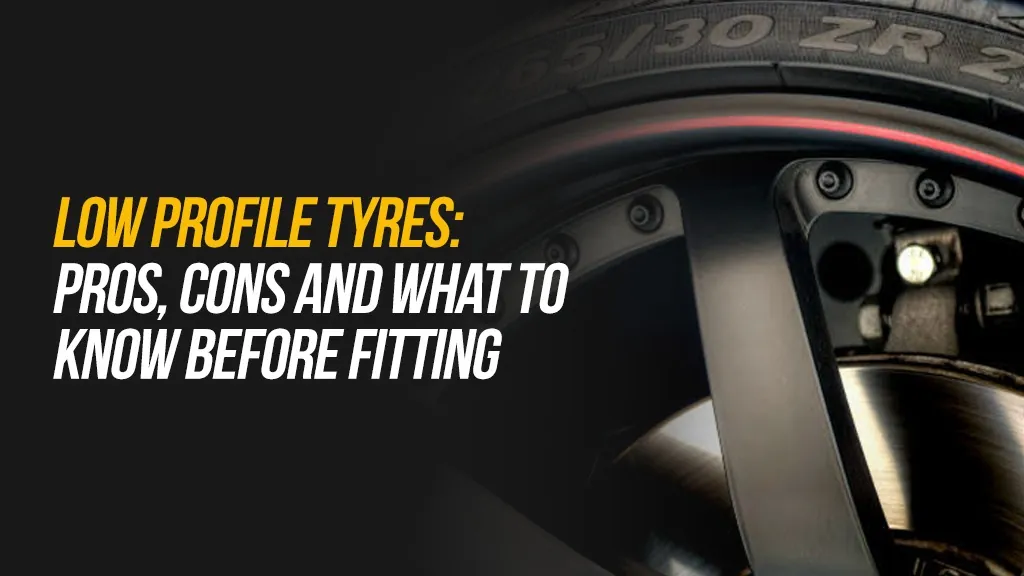
A tyre counts as low profile when its aspect ratio (the middle number in a size like 225/40 R18) is 50 or below, meaning the sidewall is 50% or less of the tyre’s width. They deliver sharper steering, shorter dry-road braking and a more planted look, but you trade away ride comfort, pay more, and get less protection against potholes and kerbs. For performance cars driven on decent roads, that trade often makes sense. On rough urban routes, it’s a closer call than the showroom suggests.
Key takeaways
- A tyre is low profile when its aspect ratio, the middle number in the size, sits at 50 or below.
- Shorter, stiffer sidewalls sharpen steering and reduce cornering flex, which is why sports cars run them.
- That same short sidewall gives less cushioning, raising the risk of rim and tyre damage on poor surfaces.
- Low profile tyres usually cost more, wear faster and lose air quicker than standard equivalents.
- Changing wheel or tyre size is a modification. Tell your insurer before you fit them.
- Correct pressure matters more here, because there’s less air volume to mask an underinflated tyre.
What actually makes a tyre “low profile”?
Look at any sidewall and you’ll see something like 225/40 R18. The 225 is the width in millimetres. The R18 is the rim diameter in inches. The number in the middle, 40, is the one that matters here. It tells you the sidewall height is 40% of the tyre’s width. The lower that number, the shorter the sidewall, and the flatter the tyre looks against the wheel.
Anything at 50 or below is generally treated as low profile. Back in the 1970s a 70-series tyre was considered low. Standards have shifted. Today’s performance hatchbacks and saloons routinely run 45s and 40s, and some go lower still. If you want a fuller breakdown of what every digit and letter on the sidewall means, our guide to tyre markings covers it properly.
There’s a design reason it works. A tall sidewall acts like a second spring, flexing when you corner or brake. Cut that height down and there’s simply less rubber to deform, so the tyre feels more direct.
The pros: where low profile tyres earn their keep
Handling is the headline. With less sidewall flex, steering inputs translate to the road faster. The car feels sharper turning into a bend and steadier holding a line through it. Enthusiasts describe it as feeling glued to the tarmac, and that’s not marketing fluff, it’s basic geometry.
Braking benefits too, at least on dry surfaces. The wider tread and larger contact patch give more grip, which can shorten stopping distances when you need them. Bigger rims also leave room for bigger brake discs, which helps.
Then there’s the obvious one. They look the part. Larger alloys paired with a slim band of rubber give a car a planted, purposeful stance, and that’s honestly why a lot of drivers fit them in the first place. Fuel economy gets a small nod as well, since stiffer sidewalls and lower rolling resistance can trim consumption slightly, though heavier wheels can cancel that gain out. Don’t buy them expecting savings at the pump.
The cons: the trade-offs nobody mentions in the showroom
Ride comfort is the first thing you’ll notice, usually on the drive home. Less sidewall means less cushioning, so every expansion joint, drain cover and rough patch comes through the seat. On a smooth A-road it’s fine. On a scarred city street it gets old quickly.
The bigger worry is damage. This is where UK roads and low profile tyres genuinely clash. A short sidewall gives the wheel far less protection when you hit a pothole or clip a kerb, and there’s a smaller air cushion to absorb the impact. The result can be a buckled rim, a split tyre, or both at once. Given that punctured tyres were the single most common form of pothole damage in Confused.com’s research, and the RAC’s Pothole Index shows breakdowns rising again through 2026, this isn’t a rare event. If you do catch a pothole, it’s worth knowing what to check afterwards and when a tyre needs replacing, because sidewall damage isn’t always obvious from the outside.
Cost is the other pinch. Low profile tyres carry a premium at purchase, thanks to their construction and lower production volumes, and the softer performance compounds often used on them wear faster. So you pay more, more often. They also generate more road noise, and they lose pressure faster because there’s less air in there to begin with. That last point catches people out.
One call and a fitter comes to the car
Home, work, roadside or car park, anywhere in London and across the UK. Tyres on board and balancing done on site.
20 to 30 min ETA in LondonCars, vans and luxury vehiclesOpen 24/7, seven days
Low profile vs standard tyres at a glance
Sometimes it’s easier to see the trade-offs side by side. Here’s how the two stack up on the things drivers actually care about.
| Factor | Low profile (50 or below) | Standard profile (55 and above) |
|---|---|---|
| Steering response | Sharper, more direct | Softer, more relaxed |
| Ride comfort | Firmer, bumps felt more | Smoother, better cushioning |
| Dry braking | Strong, larger contact patch | Good, less grip at the limit |
| Pothole and kerb resistance | Low, rim more exposed | Higher, sidewall absorbs impact |
| Wear rate | Faster on soft compounds | Slower, generally longer life |
| Purchase cost | Higher | Lower |
| Best suited to | Performance cars, smooth roads | Everyday cars, mixed UK roads |
None of this makes low profile tyres a bad choice. It makes them a specific one. The right pick depends on your car, your roads and what you want from the drive.
What to check before you fit them
A few things are worth sorting out before the fitter turns up, not after.
First, insurance. Fitting larger wheels or a different tyre size counts as a modification, and you need to tell your insurer. Skip that step and you risk invalidating your cover, which is a costly way to save a phone call.
Second, sizing. Vehicle manufacturers allow only a small change from the original tyre dimensions, and going beyond that can throw off your speedometer reading and even foul the bodywork. Staying within the recommended overall diameter keeps things legal and predictable. Check the manual or the plate inside the driver’s door.
Third, pressure. This one’s easy to overlook and genuinely important. Because low profile tyres hold less air, an underinflated one hides its condition better and stresses the sidewall harder. Getting the numbers right protects both the tyre and the alloy, and our tyre pressure guide explains how to find and hit the correct figure for your car.
And keep the legal basics in mind whatever you fit. The UK minimum tread depth is 1.6mm across the central three-quarters of the tyre, and worn or damaged tyres will fail an MOT regardless of how good they look. If a low profile tyre does pick up a nail or a slow leak, a mobile puncture repair may still be viable, provided the damage sits within the repairable central tread area and meets BS AU 159 standards.
Are they worth it on UK roads?
Here’s my honest take after years of fitting both. If you drive something built for low profiles, mostly on maintained roads, and you value how the car handles, they’re a fair choice and they’ll reward you. If your daily route is a minefield of potholes and speed bumps, a slightly higher profile will save you money and grief without ruining the drive.
There’s a practical upside worth mentioning too. Low profile tyres are more likely to need attention at awkward moments, a split after a pothole, a fast pressure loss, a kerbed rim on a school run. A mobile tyre fitting service that comes to your home, work or the roadside takes a lot of the pain out of that, especially when the tyre you need isn’t the sort your local garage keeps in stock.
A fitter’s closing thought
Low profile tyres are a genuine trade, not a straight upgrade. You buy sharper handling and a better-looking car, and you pay for it in comfort, cost and vulnerability to bad tarmac. Neither camp is wrong. The mistake is fitting them without knowing what you’re signing up for, then being surprised when the first deep pothole cracks a rim. Match the tyre to your car and your roads, keep the pressures honest, and they’ll do exactly what they promise. Just don’t expect them to forgive a pothole the way a taller sidewall would.
One call and a fitter comes to the car
Home, work, roadside or car park, anywhere in London and across the UK. Tyres on board and balancing done on site.
20 to 30 min ETA in LondonCars, vans and luxury vehiclesOpen 24/7, seven days