Jump to a section
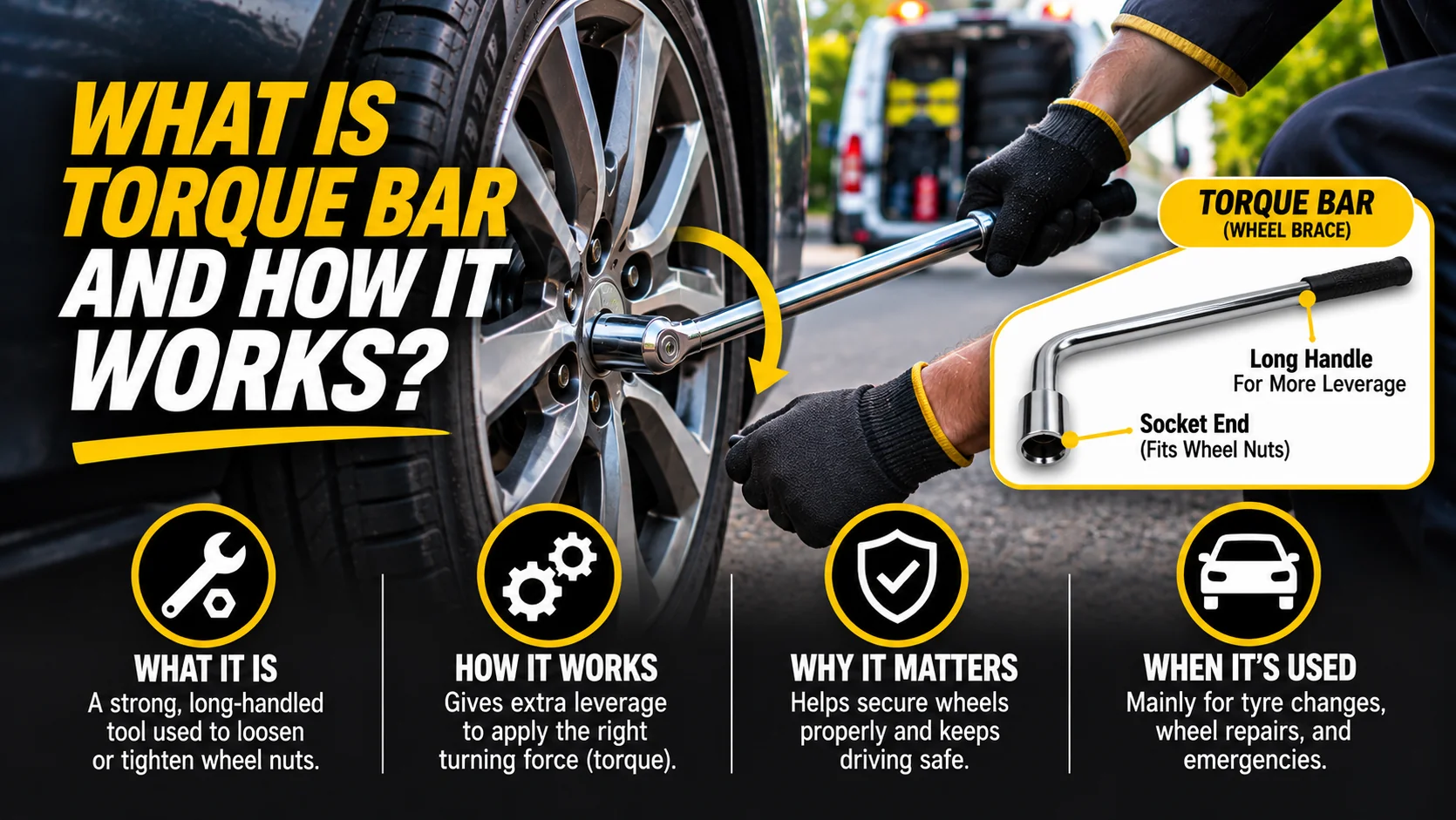
Watch a tyre fitter work and you’ll hear the rattle of an impact wrench doing up the wheel nuts. What you might not notice is the coloured bar sitting between the gun and the socket. That’s a torque bar, and it’s there to stop your wheel nuts being hammered on too tight.
Quick answer: A torque bar (also called a torque stick or torque limiting extension) is a steel extension that fits between an impact wrench and a socket. It’s built to twist slightly once it reaches a set torque, such as 108 Nm. After that point, it soaks up the hammer blows from the impact gun instead of passing them to the wheel nut, which helps prevent over-tightening.
Key takeaways
- A torque bar limits torque. It doesn’t measure it, so it isn’t a replacement for a torque wrench.
- It only works with an air (pneumatic) or electric impact wrench, not a normal ratchet.
- Each bar has a fixed rating, usually printed on it and colour coded by brand.
- Good practice is to run the nuts up with a torque bar, then finish with a calibrated torque wrench to the vehicle maker’s figure.
- Most passenger cars need somewhere around 110 to 120 Nm on the wheel nuts, but always check your own vehicle’s spec.
What Is a Torque Bar?
A torque bar is a wheel fitting tool used to tighten wheel nuts and bolts quickly without going past a set limit. You’ll see it sold under a few different names:
- Torque stick
- Torque extension bar
- Torque limiting extension
- Torsion socket (when the socket is built into the bar)
They’re all the same idea. One end connects to the square drive of an impact wrench (usually 1/2 inch for cars and vans), and the other end holds the socket that fits your wheel nut. Many have a protective plastic sleeve to stop the socket marking alloy wheels.
A quick note to avoid confusion: a torque bar isn’t the same thing as a torsion bar (a type of suspension spring), a torque rod (a suspension link on trucks) or a breaker bar (a long handle used to loosen stubborn nuts). They share some physics, but they do very different jobs.
How Does a Torque Bar Work?
The clever part is that there’s nothing clever inside it. No springs, no clutch, no moving parts. It’s just a carefully made piece of steel.
Most torque bars are made from chrome molybdenum (chrome moly) steel and have a slimmer section along the shaft. That thinner section acts like a small torsion spring. According to EngineerFix, once the nut’s resistance reaches the stick’s rating, the shaft twists elastically and absorbs the impact energy, so little extra torque reaches the fastener.
Here’s what happens step by step:
- The impact wrench delivers rapid hammer blows through the bar.
- While the nut is still spinning freely, the bar passes those blows straight through.
- As the nut seats against the wheel, resistance builds.
- At the bar’s rated torque, the thin section starts to flex with each blow.
- That flex soaks up the energy, so the nut stops getting meaningfully tighter.
This is also why the rating relates to thickness. Lower rated bars have a visibly thinner shaft because they need to flex sooner. A bar meant for a van wheel will look chunkier than one for a small hatchback.
It also explains why a torque bar is useless on a hand ratchet. It relies on the short, sharp pulses of an impact gun. A steady pull from your arm just twists the whole thing like a regular extension.
Torque Bar Ratings, Sizes and Colour Codes
Torque bars come in sets because different vehicles need different wheel nut torque. Ratings are usually stamped on the bar in Nm, ft-lb, or both. For reference, 1 ft-lb is about 1.356 Nm.
Here are some real examples from tools sold in the UK and elsewhere:
| Tool example | Drive size | Rating | Typical use |
|---|---|---|---|
| Laser Tools 6679 torsion sockets | 1/2 inch | 108 Nm (80 lb-ft) | Cars |
| Sealey 1/2″ torque sticks | 1/2 inch | 90 to 135 Nm range | Cars and light commercial vehicles |
| Craftsman 5 piece set | 1/2 inch | 65, 75, 90, 100 and 140 ft-lb | Cars, SUVs, light trucks |
| Laser Tools torque bar sockets | 1 inch | 450 Nm and 600 Nm | Commercial and HGV wheels |
About the colours: most sets are colour coded so a fitter can grab the right one quickly. The catch is that there’s no universal standard. A yellow bar from one brand won’t necessarily match a yellow bar from another, so the stamped number is what counts.
Torque Bar vs Torque Wrench vs Breaker Bar
People mix these up a lot, which is understandable because they all deal with torque. This table shows the difference at a glance.
| Torque bar | Torque wrench | Breaker bar | |
|---|---|---|---|
| Main job | Stop an impact gun over-tightening | Tighten to an exact figure | Loosen tight or seized nuts |
| Used with | Impact wrench only | By hand | By hand |
| Adjustable? | No, fixed rating per bar | Yes, set to any value in its range | No |
| Accuracy | Approximate | Precise when calibrated | Not a measuring tool |
| Speed | Very fast | Slower | Not used for tightening |
So a torque bar gives you speed with a safety ceiling. A torque wrench gives you the final, accurate number. On a proper tyre fitting job, you’ll often see both.
How Tyre Fitters Use a Torque Bar
On a mobile tyre fitting job, time matters, but so does getting the wheel on safely at the roadside or on a driveway. The usual routine looks like this:
- Start each nut by hand. This avoids cross threading, which an impact gun can do in a second.
- Pick a bar below the target torque. EngineerFix notes that many professionals choose a stick rated up to 20% under the final figure. That leaves room for the final step without any risk of going over.
- Run the nuts up in a star (diagonal) pattern. This pulls the wheel evenly onto the hub instead of tilting it.
- Lower the car and finish with a torque wrench. The calibrated wrench is set to the vehicle maker’s spec and brings each nut to the exact value.
If you’re curious about the rest of the kit that comes out of the van, we’ve covered it in our guide to the tools mobile tyre fitters use.
One call and a fitter comes to the car
Home, work, roadside or car park, anywhere in London and across the UK. Tyres on board and balancing done on site.
20 to 30 min ETA in LondonCars, vans and luxury vehiclesOpen 24/7, seven days
Limitations of Torque Bars
Torque bars are handy, but they’re not perfect, and it’s worth being honest about that.
- They’re approximate. Jalopnik’s tool review gives the example that an extension rated for 90 lb-ft might only tighten to 87 lb-ft. One manufacturer, Genius Tools, states its extensions are accurate to within 4%. Close, but not exact.
- Very powerful guns can push past the limit. The Drive reports that high torque cordless impacts may overpower a stick’s rating. Holding the trigger for ages after the bar has started flexing doesn’t help either.
- They can wear. Steel that flexes thousands of times can drift from its rating over time. Some sets, like the Sealey AK2242, include a twist distortion marking so you can check whether a bar is still serviceable.
- They need a decent impact wrench. A weak gun or a drill won’t produce enough force to make the bar work as intended.
None of this makes torque bars bad tools. It just means they’re the first step, not the final word.
Why Correct Wheel Nut Torque Matters
Wheel nuts are safety critical. Get the torque wrong in either direction and you’ve got a problem.
Too tight: Laser Tools points out that over-tightened nuts can be hard or impossible to undo, and can strip threads or stretch wheel studs until they turn brittle. Tool makers such as Steelman also link over-tightening to sheared studs and rounded nuts. If you’ve ever had a flat and couldn’t shift a nut with the wheel brace, there’s a good chance it was rattled on with no torque control at all.
Too loose: Continental explains that loose nuts carry a small but real risk of the wheel coming off while driving. The odds are low, but the outcome is serious.
What’s the right figure? It depends on the car. Continental’s guidance says it typically ranges from 110 to 120 Nm for cars. Vans, 4x4s and commercial vehicles can be much higher. Your owner’s handbook has the exact number.
Continental also recommends having wheel nuts checked after roughly 30 miles (50 km), because the wheel can settle slightly on the hub. That’s especially worth doing after new alloys, alloy wheel refurbishment or a change of locking wheel nuts.
Frequently Asked Questions
Is a torque bar the same as a torque stick?
Yes. Torque bar, torque stick, torque extension bar and torque limiting extension all describe the same tool.
Can I use a torque bar instead of a torque wrench?
It’s not a good idea for the final tightening. A torque bar stops gross over-tightening, but it can land a little under or over the target. Finish with a calibrated torque wrench.
Can I use a torque bar with a ratchet or breaker bar?
No. It only works with the hammering action of an impact wrench. With a hand tool, it just behaves like a normal extension.
Which torque bar do I need for my car?
Find the wheel nut torque in your handbook, then choose a bar rated slightly below that figure. Use a 1/2 inch drive bar for most cars and vans, and finish with a torque wrench.
Should a tyre fitter use a torque bar when changing my tyre?
It’s a sensible part of the process, especially if an impact gun is being used. Whether the job is a puncture repair or a full tyre change, the last step should always be a torque wrench set to your vehicle’s spec. If you want to know what a proper fitting looks like from start to finish, our piece on how professional mobile tyre fitters work to garage standards walks through it.
One call and a fitter comes to the car
Home, work, roadside or car park, anywhere in London and across the UK. Tyres on board and balancing done on site.
20 to 30 min ETA in LondonCars, vans and luxury vehiclesOpen 24/7, seven days