
Jump to a section
- Key takeaways
- What is actually in the kit
- What a sealant kit can and cannot fix
- The 50mph, 125 mile rule
- Does sealant ruin your tyre?
- Using one properly, step by step
- Why kits leave people stranded
- Sealant kit vs spare wheel vs calling a fitter
- Your kit has an expiry date
- When to skip the kit entirely
- FAQs
Open the boot of almost any car built in the last decade and you will find a small bottle of sealant and a 12V compressor where the spare wheel used to sit. It is called a tyre mobility kit, or a tyre repair kit, and most drivers have never used one.
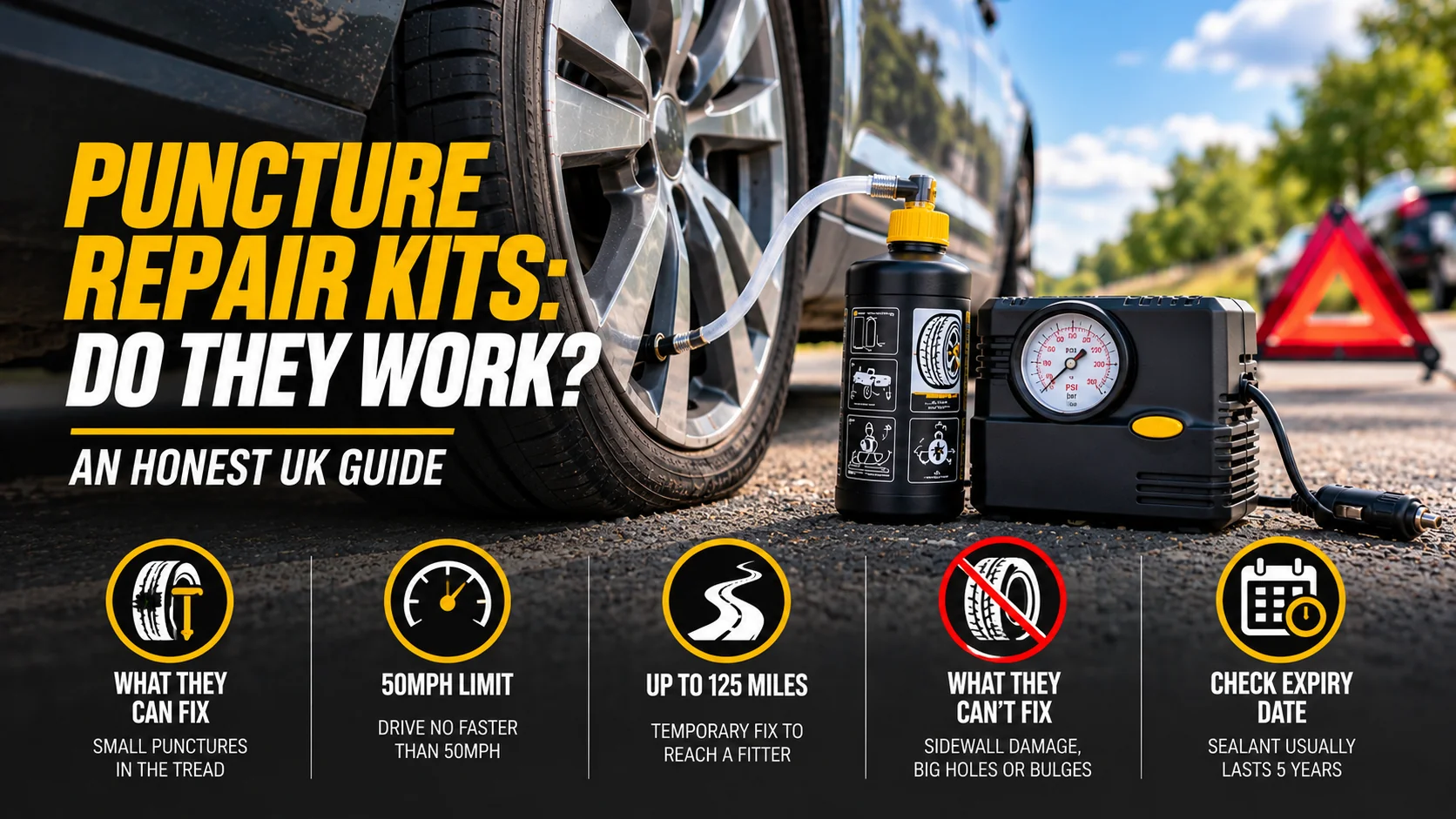
Short answer: Yes, puncture repair kits work, but only for one narrow job. A sealant kit can temporarily seal a small puncture (roughly 4mm to 6mm) in the central tread so you can drive up to about 125 miles at no more than 50mph to reach a fitter. It cannot fix sidewall damage, big holes, a tyre that has come off the rim, or a tyre already driven on flat. It is a get-you-moving tool, not a repair.
Key takeaways
- Sealant kits seal small tread punctures only, typically up to 4mm to 6mm depending on the product.
- Most manufacturers cap you at 50mph (80km/h) and 125 miles (200km) after using one.
- They do nothing for sidewall cuts, shoulder damage, bulges, or a tyre that is fully off the bead.
- Modern OE-spec gel sealants wash out with water, so a proper BS AU 159 repair is often still possible afterwards. Older aerosol foams are messier.
- Sealant expires, usually after about five years. An out of date bottle is a bottle that may not seal.
What is actually in the kit
Two parts, usually. A bottle of liquid sealant and a small 12V compressor that plugs into the cigarette lighter socket. Some kits combine both into one canister.
The sealant is a latex or natural rubber based gel. You screw the bottle onto the tyre valve, squeeze or pump the liquid in, then inflate with the compressor. As the wheel turns, the gel gets flung outwards and plugs the hole from the inside while the air pressure holds it there. Vibration and a bit of heat help it set.
Some products use what Ring Automotive calls particle gel technology, where suspended particles bridge the hole rather than relying on the liquid alone. Aerosol tyre foams are a different, older thing. They inflate and seal in one go but tend to be harder to clean out afterwards.
The important bit: nothing is being repaired. The hole is still there. You have made a temporary plug that is holding air for now.
What a sealant kit can and cannot fix
This is where most of the disappointment comes from. Drivers assume the kit covers any flat tyre. It doesn’t.
| Damage | Will a sealant kit work? |
|---|---|
| Nail or screw in the central tread, under 4-6mm | Usually yes |
| Slow puncture from a small sharp object | Usually yes |
| Puncture in the shoulder (outer edge of tread) | Unreliable, and not repairable later anyway |
| Any sidewall cut, split or bulge | No |
| Hole larger than about 6mm | No |
| Tyre driven on while flat | No, the inner structure is already damaged |
| Tyre off the rim or bead broken | No |
| Two flat tyres | No, one bottle treats one tyre |
| Valve or TPMS sensor leak | No, the leak is not in the rubber |
Kia’s owner handbooks put the practical limit around 4mm, while sealant makers like Ring rate theirs up to 6mm. Treat whichever number is on your bottle as optimistic rather than guaranteed. A screw head looks small until you pull it and see the hole underneath.
Worth knowing: the damage that strands people most often in the UK is pothole damage, and that usually shows up as a sidewall bulge or a split, not a neat puncture. Sealant does nothing for either.
The 50mph, 125 mile rule
Once the sealant is in and the tyre is reinflated, you are on borrowed time. Vehicle manufacturers are consistent here. Kia, Continental and Ring all specify a maximum of 80km/h (50mph) and a maximum of 200km (125 miles) before the tyre goes to a professional.
Kia even tells you to peel the speed limit sticker off the sealant bottle and stick it somewhere you can see it from the driver’s seat, which tells you how easy it is to forget.
Drive gently for the first mile or so, then stop and check the pressure. If it has dropped again, the seal has not taken and you should stop driving. Pushing on with a half sealed tyre at motorway speed is how a slow leak turns into a blowout.
Does sealant ruin your tyre?
This is the most common complaint about kits, and the answer is more nuanced than the internet suggests.
A proper tyre repair in the UK follows BS AU 159, the British Standard the British Tyre Manufacturers’ Association works to. The tyre comes off the rim, gets inspected inside and out, and a combined plug and patch goes in from the inside. That only works if the inner liner is clean. Sealant coats the inner liner.
So the real question is whether the sealant comes off.
- OE-spec gel sealants (the type supplied with most new cars, and replacements like Ring’s RTS450) are designed to rinse out with water. Ring states this explicitly on its spec sheet. A fitter can wash the liner, dry it, and carry out a standard repair.
- Aerosol foams and some cheap sealants are stickier and harder to clear, and plenty of fitters will simply refuse the job rather than gamble on a bond that might fail.
In practice it also depends on who you take it to. Some workshops have a blanket no-sealant policy because cleaning a liner takes time and they would rather sell a tyre. Others will do it. If you have used a kit, say so up front and ask whether they will still assess it for repair. Honest shops will tell you either way.
And to be fair to the sealant, in a lot of cases the tyre was already finished. If you drove any distance on a soft or flat tyre before reaching for the bottle, the sidewall has been flexing and overheating, and that damage is permanent regardless of what you squirt in afterwards.
One call and a fitter comes to the car
Home, work, roadside or car park, anywhere in London and across the UK. Tyres on board and balancing done on site.
20 to 30 min ETA in LondonCars, vans and luxury vehiclesOpen 24/7, seven days
Using one properly, step by step
Most kit failures are user error, not product failure.
- Stop somewhere safe. Never do this on a motorway hard shoulder. Get behind a barrier and call for assistance instead.
- Find the damage. Roll the car forward slightly so the puncture is visible. If it is in the sidewall or shoulder, stop here. The kit will not help.
- Leave the nail or screw in place. Pulling it out makes the hole bigger and lets the sealant escape.
- Rotate the wheel so the puncture sits near the top. This keeps the sealant pooling where it needs to be.
- Connect the bottle to the valve and empty it in. Most modern kits are valve-through, so you do not need to remove the valve core.
- Inflate to the pressure on your door placard, not to whatever feels firm.
- Drive immediately, slowly, for a couple of miles to spread the gel. Then stop and recheck the pressure.
- Book the tyre in straight away. Same day if you can.
Skipping step 7 is the classic mistake. The sealant needs rotation to work. Leaving the car parked overnight with sealant sitting in the bottom of the tyre achieves very little.
Why kits leave people stranded
The RAC reviewed 313 new cars on sale and found only eight, about 2.6%, came with any kind of spare wheel as standard. Manufacturers dropped them to save up to 20kg of weight and meet emissions targets. An AA survey of 11,959 members found 82% would rather have a spare wheel than an inflation kit, and 35% said they would not feel confident using one.
That gap between what is fitted and what drivers can actually use is the real issue. A sealant kit assumes a best case puncture. Real punctures are often not best case.
The other problem is time. The AA has said that when a car has a spare, a patrol fits it and the member drives away. With an inflation kit that fails, the same job can take considerably longer because the car now needs recovery or a replacement tyre brought to it.
If you want the full comparison of what you could be carrying instead, our guide to spare wheel types covers full size, space saver and the rest.
Sealant kit vs spare wheel vs calling a fitter
| Sealant kit | Space saver spare | Mobile tyre fitter | |
|---|---|---|---|
| Fixes the problem permanently | No | No | Yes |
| Works on sidewall damage | No | Yes | Yes |
| Needs you to lift and jack | No | Yes | No |
| Speed restriction afterwards | 50mph | Usually 50mph | None |
| Boot space and weight | Minimal | Around 10-20kg | None |
| May complicate a later repair | Sometimes | No | No |
A kit and a mobile fitter are not really competing. The kit buys you the first few miles. Someone still has to remove the tyre, inspect the inside, and either carry out a BS AU 159 repair or fit a new one. That is the job we do at the roadside, and a technician can also tell you within a minute whether the puncture was ever repairable. If you want to know where the line sits, we have broken down which punctures can and cannot be repaired in detail.
Your kit has an expiry date
Here is the part nobody checks until it matters. Tyre sealant goes off. Ring specifies replacement every five years, and Sealey’s refills carry a five year expiry too. Vehicle handbooks tell you not to use sealant past the date printed on the bottle, because expired gel may not seal at all.
If your car is five years old and still has the factory bottle, it is probably already past it. Replacement 450ml bottles sit at roughly £14 to £20 depending on brand, which is cheap insurance for something you are relying on at midnight on an A road.
Two more small checks while you are in the boot:
- Is the compressor’s 12V lead intact, and does your car’s socket stay live with the ignition off?
- Does the sealant state it is TPMS safe? Most modern gels are, and a decent one will not harm the sensor, though it is still worth having the valve and TPMS sensor checked when the tyre is dealt with properly.
When to skip the kit entirely
Put the bottle down and call someone if any of these apply:
- The damage is on or near the sidewall
- There is a visible bulge, split or cut
- The tyre is completely flat and you have already driven on it (which does its own damage)
- You have a run-flat tyre, which is designed to get you moving without any sealant and usually should not be repaired afterwards
- Two tyres are down
- The tread is near the 1.6mm legal minimum anyway, in which case you are buying a tyre regardless
- You are on a motorway, in poor light, or anywhere you cannot work safely
In those cases a van with the right tyre on board solves the problem once. Mobile puncture repair comes to the car, assesses the damage properly, and either repairs to standard or fits a replacement on the spot.
FAQs
Do puncture repair kits actually work?
For a small puncture in the central tread, yes. The sealant plugs the hole well enough to hold pressure for a limited distance. Outside that narrow case, the honest answer is no.
How long does tyre sealant last once it is in the tyre?
It is a temporary measure, not a time-based one. Manufacturers give a distance and speed limit, typically 125 miles at 50mph, and expect the tyre to go to a fitter at the end of it. Do not leave it in for weeks.
Will a garage still repair a tyre that has had sealant in it?
Often, yes, if the sealant is a water-washable gel type and the puncture itself meets BS AU 159 criteria. Some workshops decline on principle. Tell them what you used and ask before they strip the tyre.
Can I use a kit on a run-flat tyre?
Generally not worth it. A run-flat already supports the car at zero pressure, and once it has been driven on flat the reinforced sidewall is compromised and the tyre is usually replaced rather than repaired.
Should I pull the nail out before using the sealant?
No. Leave it in. The object is partially blocking the hole and removing it lets both air and sealant out faster. The same applies if you are just driving carefully to a fitter with a nail still in the tread.
Does sealant damage TPMS sensors?
Most modern OE-spec sealants are labelled TPMS safe and should not harm the sensor. Cheap unbranded foams are more of a gamble. Either way, have the valve cleaned and checked when the tyre is dealt with.
Is it better to just carry a spare wheel?
If you have the boot space and the ability to change a wheel safely, a spare covers far more scenarios than sealant does. Plenty of cars offer one as an optional extra. For a lot of urban drivers, though, the realistic plan is a kit for small punctures and a fitter on speed dial for everything else.
One call and a fitter comes to the car
Home, work, roadside or car park, anywhere in London and across the UK. Tyres on board and balancing done on site.
20 to 30 min ETA in LondonCars, vans and luxury vehiclesOpen 24/7, seven days