
Jump to a section
- Quick answer
- Key takeaways
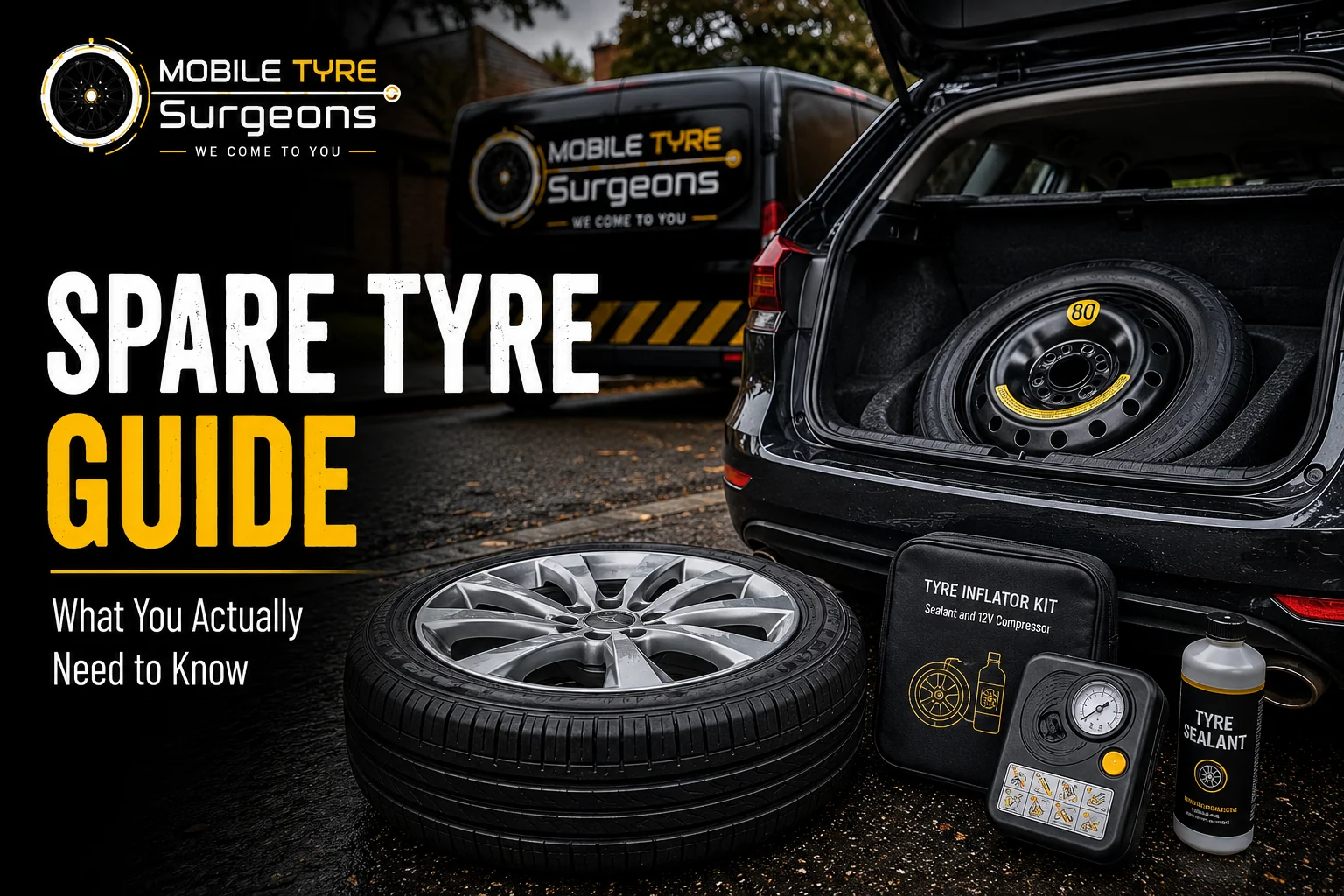
- The three main types of spare you might have
- How to use each one safely
- The 50mph rule, and what the law actually says
- Comparing your options at a glance
- Why most new cars don’t have a spare anymore
- Should you buy a spare for a car that didn’t come with one?
- What to do when you have a puncture and no spare
- A final thought
Pop the boot of a new car bought in the last few years and you might find a surprise. No spare wheel. Maybe a small bottle of sealant, maybe nothing at all. According to RAC research, just 3% of new cars sold in the UK come with a spare wheel as standard. This guide explains the types of spare you might have, how to use each one safely, and why the humble spare has quietly disappeared.
Quick answer
A spare tyre is a backup wheel or repair system that gets you moving again after a puncture. There are three common setups in UK cars today: a full-size spare, a compact space-saver, or a sealant and inflator kit. Most new vehicles ditch the full spare entirely to cut weight and free up boot space. Space-savers carry a 50mph speed limit and are meant only to reach a garage. Repair kits handle small tread punctures but not sidewall damage or large gashes.
Key takeaways
- Only around 3% of new UK cars come with a spare wheel as standard, per RAC analysis of 313 models.
- A space-saver spare is legal and safe, but limited to roughly 50mph and around 50 miles of use.
- Sealant kits only fix small punctures in the central tread, generally under 6mm wide.
- Run-flat tyres let you keep driving after a puncture, usually up to 50 miles at reduced speed.
- A spare wheel can add up to 20kg to a car, which is why manufacturers drop it.
- Sealant inside a tyre can make a later professional repair impossible, so use it as a last resort.
The three main types of spare you might have
Not all spares are equal. What sits in your boot, or doesn’t, depends entirely on how your car was specced at the factory.
The full-size spare is the traditional one. A proper wheel, matching your other four, ready to take over indefinitely. It’s the gold standard for getting out of trouble, especially somewhere remote. The catch is weight and space. A full spare can add up to 20kg to the car and eats a chunk of boot floor.
The space-saver, sometimes called a skinny or a donut, is the compromise. Narrower, lighter, and clearly marked as temporary. It does the job of getting you to a tyre fitter and not much more.
Then there’s the sealant and inflator kit. No wheel at all. Just a bottle of liquid sealant and a small 12V compressor that plugs into the car. It’s the lightest option and the one manufacturers increasingly favour.
A quick note on run-flat tyres. They aren’t a spare in the strict sense, since there’s nothing extra to fit. The tyre itself has reinforced sidewalls stiff enough to support the car for a limited distance after losing pressure. Many BMWs and some MINIs come on run-flats, which is partly why those cars rarely carry a spare.
How to use each one safely
Each type has its own rules. Get them wrong and you turn a minor inconvenience into a real risk.
Space-saver spares
Most space-savers carry a maximum speed rating of around 50mph, usually printed on the wheel or on a bright sticker. That figure isn’t a suggestion. These tyres have shallow tread and softer rubber, and they cut your cornering grip by roughly 10 to 15%. There’s no legally fixed distance limit, but around 50 miles is the widely accepted maximum before the tyre starts wearing dangerously thin.
Fit it to a non-driven axle where possible. On many cars the manual will tell you to swap wheels around so the space-saver sits on a rear, non-drive position, which protects the differential. And drive gently. No hard braking, no sharp turns, stick to the inside lane on a motorway if you have no other option.
Sealant and inflator kits
A kit only works for small punctures in the central tread area, typically under 6mm wide. Sidewall damage, big gashes, a tyre that’s been run completely flat, none of those can be sealed. You inject the sealant, reinflate with the compressor, then drive slowly so the goo spreads evenly. Manufacturers often suggest around 30mph for the first ten minutes.
One thing worth knowing. Sealant coats the inside of the tyre, and many fitters won’t carry out a proper plug-and-patch repair on a tyre that’s been gunged up, because they can’t inspect it cleanly. So a kit can quietly cost you the tyre. Honestly, that’s a trade-off plenty of drivers don’t realise they’re making.
Full-size spares
The easy one. Fit it, torque the nuts properly, and you can carry on more or less as normal. Still worth checking its pressure now and then, because a spare that’s been sitting deflated for three years isn’t much use in a crisis.
The 50mph rule, and what the law actually says
There’s a lot of confusion here, so let’s be precise. A space-saver fitted by the manufacturer is perfectly legal on UK roads, motorways included. What matters is sticking to the speed restriction marked on the wheel and meeting the same tread depth rules that apply to any tyre, which is 1.6mm minimum across the central three-quarters.
There is no statutory distance limit. The “50 miles” figure is a safety guideline, not a law. But drive on a worn-out space-saver below the legal tread depth and you’re open to a fine and penalty points, same as any bald tyre. And a car presented for its MOT with a space-saver fitted will fail, since it isn’t a permanent road wheel.
Run-flats and repair-kit fixes follow similar logic. Temporary by design, legal for the journey to a garage, not legal or safe as a long-term state.
One call and a fitter comes to the car
Home, work, roadside or car park, anywhere in London and across the UK. Tyres on board and balancing done on site.
20 to 30 min ETA in LondonCars, vans and luxury vehiclesOpen 24/7, seven days
Comparing your options at a glance
When a puncture happens, knowing what each option can and can’t do saves time and stress.
| Spare type | Speed limit | Rough range | Handles sidewall damage? | MOT-legal long term? |
|---|---|---|---|---|
| Full-size spare | Normal | Unlimited | Yes, it’s a real tyre | Yes |
| Space-saver | ~50mph | ~50 miles | Yes (it replaces the wheel) | No |
| Sealant kit | ~50mph | ~50 to 125 miles | No | No |
| Run-flat tyre | ~30 to 50mph | ~50 miles | No | No, needs replacing |
The pattern is clear. A full-size spare is the only setup that genuinely gets you out of any tyre situation. Everything else buys you time to reach professional help, nothing more.
Why most new cars don’t have a spare anymore
So why has the spare wheel become a near-extinct species? It comes down to a few overlapping pressures on manufacturers.
Weight is the big one. A spare wheel and its tools can add up to 20kg. Stripping that out improves fuel economy and lowers CO2 emissions, which matters a great deal when carmakers are measured against strict emissions targets. Less weight, better figures on paper.
Space is the second factor. Designers want flat boot floors and clever underfloor storage. A spare wheel well gets in the way.
Then there’s electric vehicles. The space beneath the boot floor on an EV is often taken up by battery components, charging cables, or electrical hardware. There simply isn’t room. As the RAC has pointed out, EVs are even less likely than petrol cars to carry a spare.
And finally, habits. Research cited by Green Flag suggests around 51% of motorists don’t know how to fit a spare wheel anyway. If half of drivers will just call for recovery, manufacturers can argue the spare is dead weight for most owners. It’s a circular argument, but a convenient one for them.
The result has consequences. The RAC reported attending close to 200,000 breakdowns in a single year where a driver had a puncture but no spare to fit. That’s a lot of people stuck at the roadside who, a decade or two ago, would have changed a wheel and driven off. For anyone who’d rather not wait, this is exactly where a mobile tyre fitting service earns its keep, since a fitter comes to you with the correct replacement tyre rather than a temporary bodge.
Should you buy a spare for a car that didn’t come with one?
This is a genuine judgement call, and the honest answer is: it depends on how and where you drive.
If you regularly cover quiet rural roads, tow, or travel long distances away from towns, a retrofit space-saver is worth considering. Specialist suppliers sell them for most popular models, along with the jack and brace you’ll also be missing. The downside is finding somewhere to store it and accepting the weight penalty you were “saved” from.
If your driving is mostly urban and you have breakdown cover, the maths shifts. A puncture in London at 2pm is an inconvenience, not a survival situation. A repair kit plus a phone often does the job. The Department for Transport and breakdown providers both note that tyre issues cause a significant share of motorway breakdowns, so whatever you choose, don’t pretend punctures won’t happen. Around a quarter of UK drivers experience one each year.
It’s also worth understanding what a sealant kit genuinely can and can’t fix before you rely on one. Our breakdown of which tyre punctures can be repaired covers the BS AU 159 standard that decides whether a tyre is salvageable at all.
What to do when you have a puncture and no spare
It happens. You hear that flat, thudding noise, pull over, and find an empty boot. Here’s the calm version of what to do next.
First, get somewhere safe. Off the carriageway, hazard lights on, everyone out and behind a barrier if you’re on a fast road. If you’re on a motorway, that means well away from the hard shoulder.
Second, assess the damage if it’s safe to. A small nail in the tread is a different problem from a shredded sidewall. The former might be sealable; the latter never is.
Third, decide your route to help. A repair kit might get you to a garage if the puncture is minor. If it isn’t, or if you’re not comfortable, calling for assistance is the sensible move. A puncture caused by a kerb strike or a deep pothole usually means the tyre is finished, and our guide to pothole damage and what to check explains the warning signs.
For drivers who’d rather skip the temporary fix entirely, emergency mobile tyre fitting means a technician arrives wherever you are, day or night, and fits a proper replacement on the spot. No 50mph crawl home, no sealant ruining the tyre. It’s also genuinely useful to know what to do when a tyre bursts on the motorway, since that’s the scenario where panic does the most damage.
A final thought
The spare wheel didn’t vanish because punctures stopped happening. They didn’t. It vanished because a few kilograms and a flat boot floor mattered more to manufacturers than the rare bad day at the roadside.
That leaves the decision with you. Know what’s actually in your boot. Check it now, not when you’re stranded. And if it turns out to be a bottle of sealant and a compressor, at least you’ll know its limits before you’re relying on it in the rain on the M1. A spare, whatever form it takes, is only useful if you understand what it can and can’t do.
One call and a fitter comes to the car
Home, work, roadside or car park, anywhere in London and across the UK. Tyres on board and balancing done on site.
20 to 30 min ETA in LondonCars, vans and luxury vehiclesOpen 24/7, seven days