

Jump to a section
- What Is a Flat Tyre?
- What is Punctured Tyre?
- How a Flat Tyre Looks Like
- How Punctured Tyre Look Like
- Flat vs. Punctured Tyres: Major Differences
- How to Fix a Flat tyre?
- What to Do If You Have a Punctured Tyre?
- Is Driving on a Flat or Punctured Tyre Safe?
- Can You Repair a Punctured Tyre?
- Conclusion: Flat or Punctured Tyre—Know What to Do!
Imagine driving on a road; suddenly, your car feels a little off balance. You stop and find out the tyre has gone flat on you. But is it a flat tyre on its own, or is it something that is puncturing it?
Aside from all this, for immediate flat tyre repair, you can use a mobile tyre fitting service for your help.
Although both can fall under the category of tyre problems, knowing the difference between a flat and punctured tyre can save you a lot of time, effort, and money. In this guide, you will learn the difference between a flat and a punctured tyre to fix it swiftly and safely.
| Feature | Flat Tyre | Punctured Tyre |
| Definition | A tyre that has lost all or most of its air, causing it to deflate entirely. | A tyre with a small hole or damage allows air to escape gradually. |
| Cause | Severe damage like a blowout, valve failure, or extreme underinflation. | A sharp object like a nail, glass, or thorn pierces the tyre. |
| Air Loss | Sudden and complete air loss. | Slow and gradual air loss over time. |
| Appearance | Fully deflated tyres, the vehicle may lean or sit unevenly. | It may appear normal initially but softens over time. |
| Detectability | Immediately noticeable while driving or inspecting the vehicle. | Harder to detect without careful inspection or noticing a pressure drop. |
| Driveability | Unsafe to drive; can cause wheel or rim damage. | Possible to drive short distances but risky and can worsen the damage. |
| Repair Options | Often requires a full tyre replacement. | It can be patched or plugged if the damage is minor. |
| Common Symptoms | Loud noise, wobbling, or vehicle pulling to one side. | Gradual loss of air pressure and lower fuel efficiency. |
What Is a Flat Tyre?
Not all flat tyres are caused by a sharp object. It could be a slow loss of air pressure due to:
Valve Stem Problem: The little valve through which air enters may become worn out and cause a slow leak.
Temperature Change: Heat and cold extremes may cause the air in your tyre to contract, an observation that has led to lower pressure.
Wear and Tear: Over time, the rubber of the tyre gets weakened, allowing air to seep out.
Often, flat tyres happen slowly, without any visible damage, and just need a simple air refill or valve replacement to fix. Yet, if the flat appears to persist or is somewhat severe, it’s worth getting it checked out by a pro.

What is Punctured Tyre?
Punctured tyres refer to when a sharp object, like nails, screws or glass, pierces the rubber and the air escapes. Here is the difference between visible foreign objects; if you find a nail, screw, or glass shard in the tyre, then the tyre is pierced as a result.
Rapid air loss: a puncture causes sudden and discernible air loss in pressure.
Uneven wear: bulging may surround the puncture, or the tyre displays peculiar wear patterns.
It’s possible to have a punctured tyre suddenly, depending on the location and size of the damage. Some may need repair, while others may not. As a rule of thumb, a puncture in the tread can be repaired, but if the sidewall is damaged, then the tyre has to be changed.
How a Flat Tyre Looks Like
A flat tyre usually shows a deflated or sagging appearance without much pressure inside the tyre. The tyre may appear low or completely squashed against the rim, mainly when the flat is caused by gradual loss of air, as no visible damage may be present. However, one side of the car may appear to be lower due to loss of air.
How Punctured Tyre Look Like
A punctured tyre generally has a clear external marking of entry by any sharp object, such as a nail or screw. You will often see the foreign object set into the tread. Usually, there can be a hissing sound along with air escaping, or the tyre can look only partially flat because of the rapid loss of air. The damage usually lives in just one specific place on the tyre.
Flat vs. Punctured Tyres: Major Differences
1. Rate of Air Loss
Flat tyre: Generally loses air slowly over time.
Punctured tyre: Rapidly loses air and, therefore, needs to be treated quickly.
2. Causes
Flat tyre: Generally, it is due to slow leakage, damage to valve stem, or changes in temperature.
Punctured tyre: Caused by sharp objects penetrating the tyre surface.
3. Visible Damage
Flat tyre: No visible signs of damage; it’s a gradual loss of air.
Punctured tyre: You are likely to see an object or a visible hole through which air leaks out of the tyre.
4. Repairability
Flat tyre: It just needs an air refill or just repairing the valve stem.
Punctured tyre: If the puncture is small and in the tread area, it can generally be repaired using a patch, whereas a puncture in the sidewall usually requires a replacement.
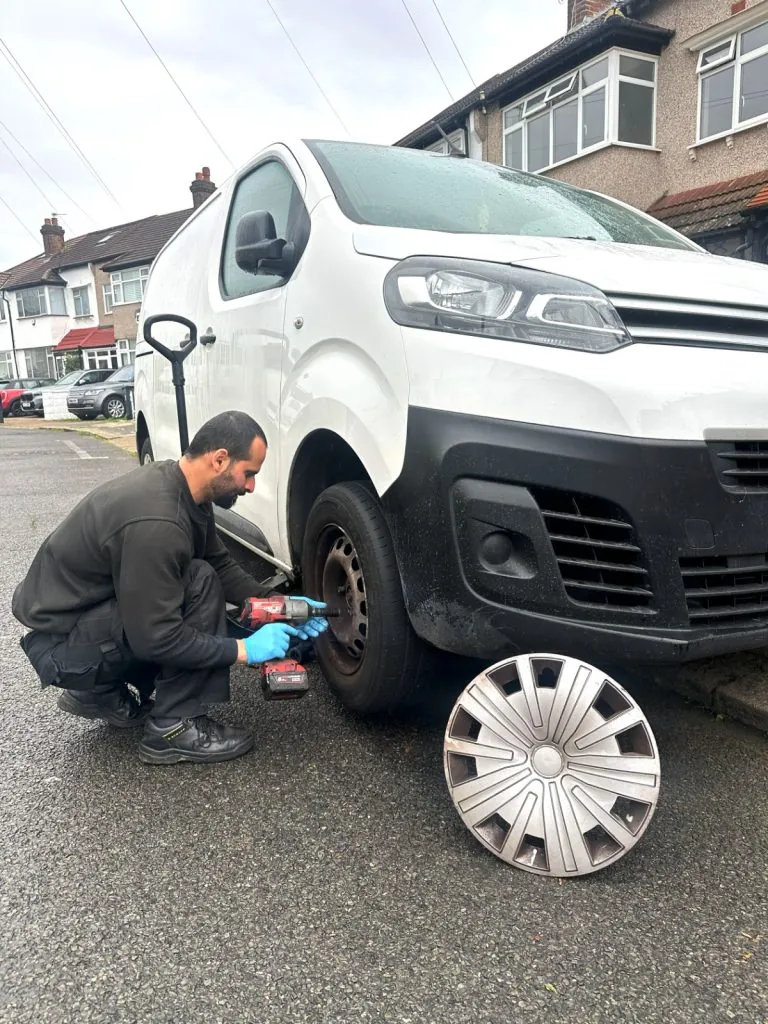
One call and a fitter comes to the car
Home, work, roadside or car park, anywhere in London and across the UK. Tyres on board and balancing done on site.
20 to 30 min ETA in LondonCars, vans and luxury vehiclesOpen 24/7, seven days
How to Fix a Flat tyre?
The flat tyre does not imply immediate replacement. Here’s how you can go about it:
Check the Valve Stem: If air escapes from the valve, it is cracked or damaged. A replacement can quickly be done at the tyre shop.
Fill Air: If the air pressure is below average, the tyre is all right. You can inflate it and drive.
Professionally Check: If the problem persists or a visible cause cannot be found, take the tyre to the workshop for an assurance of no inner damage.
What to Do If You Have a Punctured Tyre?
Punctured tyres take more time and care than normal ones. This is what to do:
Find the Object: If there is a nail or screw in the tyre, you should know the likely cause. So mark that place to ensure you keep it.
Check the Damage: Normally, a small puncture in the tread can be repaired, while if the puncture is wide or in the sidewall, it might be advisable to change the tyre.
Temporary Fixes: If you are stuck and don’t have access to a garage, you can use a tyre repair kit to fix the tyre. Just make sure it is a short-term fix.
Get a Repair Job: It is usually the most advisable thing to have the tyre professionally repaired. A large number of tyre shops can fix a punctured tyre by putting a plug or a patch, and your tyre goes back to its former state.
Mobile Tyre Fitting: A vital meeting awaits you. Do you have a flat tyre? Don’t worry—choose our mobile tyre fitting service to get your tyre fitted on the spot. Learn more about mobile tyre fitting and how it works to have a better idea of service.
Is Driving on a Flat or Punctured Tyre Safe?
Neither a flat nor a punctured tyre is safe to drive on. A flat tyre, no matter how mild it seems, could hamper your handling, fuel efficiency, and safety. A punctured tyre is even more dangerous because it can blow out without warning and in a matter of seconds. Whenever you suspect a flat or a punctured tyre, always stop immediately and take the proper steps to resolve the situation by calling for roadside assistance, using a spare, or going into the nearest tyre shop.
Can You Repair a Punctured Tyre?
Yes, many punctured tyres can be repaired—but not all. The location of the puncture plays a massive role in whether the tyre can be salvaged. Small punctures in the tread are usually repairable, while sidewall damage often requires a total replacement. Always have a professional assess the damage to determine if a repair is possible.
Conclusion: Flat or Punctured Tyre—Know What to Do!
While flat and punctured tyres result in a loss of air, they have distinct causes and symptoms. Understanding their differences will help you react appropriately and take steps to fix the issue. Whether dealing with a slow air leak in a flat tyre or a sudden puncture from a sharp object, always prioritize safety and get your tyres checked by a professional when necessary.
Keep an eye on your tyre pressure, and remember that regular tyre maintenance can prevent unexpected road issues. If you’re ever in doubt, don’t hesitate to contact your mobile tyre fitting service professionals for expert advice and fast solutions!
One call and a fitter comes to the car
Home, work, roadside or car park, anywhere in London and across the UK. Tyres on board and balancing done on site.
20 to 30 min ETA in LondonCars, vans and luxury vehiclesOpen 24/7, seven days