
Jump to a section
- Quick Answer
- Key Takeaways
- Why Diagnosing the Shake Matters
- Match the Symptom to the Cause
- 1. Wheel Balancing (The Usual Culprit)
- 2. Tyre Problems
- 3. Wheel Alignment
- 4. Warped Brake Discs
- 5. Wheel Bearings
- 6. Bent Alloy Wheels
- 7. Suspension and Steering Components
- 8. Loose Wheel Nuts
- What to Do First
- When to Stop Driving
- How a Mobile Fitter Handles This
- FAQs
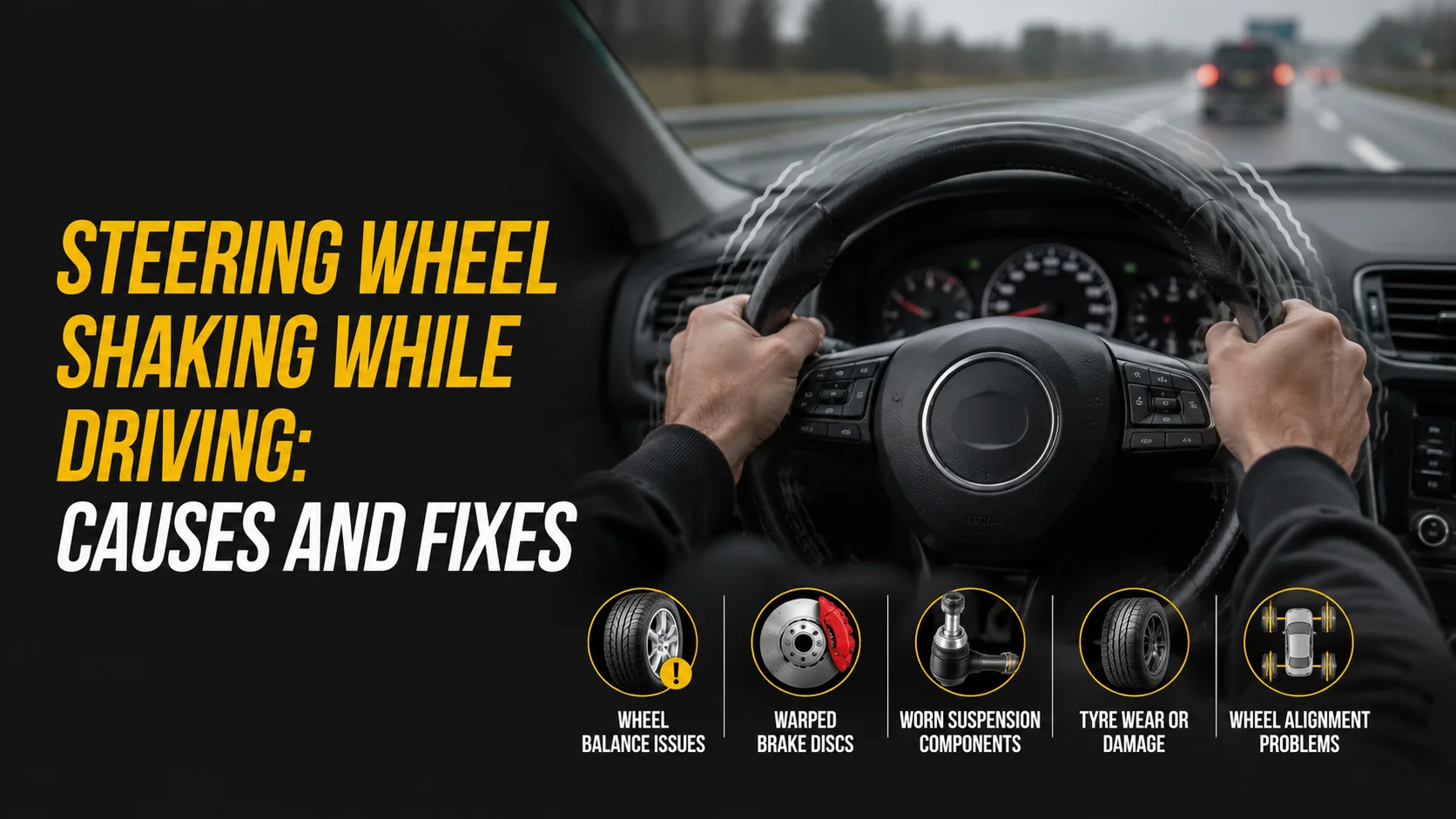
A shaking steering wheel is your car’s way of saying something is off, usually with your tyres, wheels, or brakes. Sometimes it’s a five-minute fix. Sometimes it’s a sign you shouldn’t drive another mile.
This guide walks through what causes the shake, how to narrow it down based on when it happens, and what to do about it.
Quick Answer
If your steering wheel shakes only at motorway speeds (roughly 50-70 mph), the most likely cause is unbalanced wheels or a tyre issue. If it shakes only when you brake, warped brake discs are the usual suspect. If it shakes all the time or gets worse over bumps, suspension or wheel bearing wear is more likely.
Key Takeaways
- Speed-dependent shake between 50-70 mph = wheel balancing, nearly every time.
- Shake through the brake pedal too = warped discs or sticking caliper.
- Constant shake with a humming noise = wheel bearing.
- Never ignore a sudden new vibration. Something has changed.
- Most tyre-related shakes can be sorted at your driveway with a mobile fitter, no garage trip needed.
Why Diagnosing the Shake Matters
Vibrations feel harmless. They aren’t. A wheel that’s out of balance chews through tyre tread unevenly, which then makes the shake worse, which then wears the tread faster still. It’s a loop that ends with you buying tyres earlier than you should have.
Worse, some causes (a separated tyre belt, a badly worn wheel bearing, a loose wheel nut) can fail without much warning. So it pays to work out what’s going on rather than hoping it settles.
Match the Symptom to the Cause
The single most useful clue is when the shake happens. Here’s a rough diagnostic table:
| When the shake happens | Most likely cause | Also worth checking |
|---|---|---|
| Only at 50-70 mph, smooths out above/below | Wheel balancing | Tyre pressure |
| Gets worse the faster you go | Bent alloy, separated tyre belt | Balancing |
| Only when you brake | Warped brake discs | Sticky caliper, loose wheel nuts |
| All the time, worse over bumps | Worn suspension, tie rod, ball joint | Wheel alignment |
| Constant, with a hum that changes with speed | Wheel bearing | CV joint |
| Started right after new tyres or a kerb hit | Balancing, bent rim, or damaged tyre | Alignment |
Now let’s go through the main causes properly.
1. Wheel Balancing (The Usual Culprit)
This is the number one cause. Every wheel and tyre assembly has small weight variations, and small lead or steel weights are clipped onto the rim to counter them. Weights fall off. Tyres wear unevenly. New tyres need balancing from the start.
You’ll feel unbalanced front wheels as a shake in the steering wheel. Unbalanced rear wheels usually shake the seat instead.
The fix: Wheel balancing on a spin balancer. It takes about 10 minutes per wheel. Any decent mobile fitter can do this at your home or workplace, and it’s included as standard with any tyre fitting we carry out.
One call and a fitter comes to the car
Home, work, roadside or car park, anywhere in London and across the UK. Tyres on board and balancing done on site.
20 to 30 min ETA in LondonCars, vans and luxury vehiclesOpen 24/7, seven days
2. Tyre Problems
Tyres cause a fair share of shakes on their own, quite apart from balancing.
- Uneven wear from poor alignment or long-neglected balancing creates flat spots that thump around at speed.
- A separated belt inside the tyre (common after a heavy pothole hit or in older tyres) creates a persistent shake that balancing won’t fix. The tyre needs replacing.
- Low pressure on one tyre can throw off the feel of the steering, especially on motorway runs. Check pressures cold, once a fortnight ideally.
- Bulges or sidewall damage are more serious. A visible bulge means the internal cords have gone. Don’t drive on it.
Have a walk around the car and look at the tread. Uneven wear across the width usually means alignment. Cupped or scalloped wear (little dips) points to worn suspension or long-term balancing neglect.
3. Wheel Alignment
Alignment doesn’t usually cause vibration on its own, but it causes the uneven tyre wear that then causes vibration. If your car pulls to one side, or if the steering wheel isn’t centred when you’re going straight, alignment is off.
Kerb strikes, potholes, and speed bumps are the main causes. So is fitting new suspension components without a follow-up alignment check.
4. Warped Brake Discs
If the shake only appears when you press the brake pedal (and often you feel it through the pedal itself as well as the steering wheel), your brake discs have probably warped. Heat from heavy or prolonged braking causes uneven expansion, and the pad now grips a slightly wonky surface.
The fix: Skimming the discs works occasionally, but replacement is the honest answer most of the time. This is a garage job, not something a mobile tyre unit will handle.
5. Wheel Bearings
A failing wheel bearing gives you a constant vibration that gets worse with speed, often paired with a low hum or growl that changes as you turn. Turn left and the noise fades? Right-hand bearing is the suspect (turning shifts load onto the opposite side).
Wheel bearings don’t fail gracefully. Get it checked promptly.
6. Bent Alloy Wheels
Potholes in the UK do real damage. A bent rim throws off balance in a way that lead weights can’t quite mask, and you’ll often get a shake that no amount of re-balancing sorts out permanently.
Some alloys can be refurbished and straightened; badly bent ones need replacing. A visual check while the wheel is off is usually enough for a fitter to spot the problem.
7. Suspension and Steering Components
Worn tie rod ends, ball joints, or bushes create play in the front end. You’ll feel it as a shake that’s worse over rough ground, sometimes with a clunk over bumps. Steering may also feel vague or wander.
This is a mechanic’s job, and it’s worth attending to. Worn steering components fail the MOT and, more importantly, they fail while you’re driving.
8. Loose Wheel Nuts
Rare but serious. If your car has recently had wheels off (new tyres, brake work, or a spare fitted), and a shake shows up straight after, pull over safely and check the wheel nuts are properly torqued. This is exactly why any decent fitter torques to manufacturer spec and hand-checks before you drive off.
What to Do First
If the shake is new, work through this quickly:
- Check tyre pressures, all four, cold. This costs nothing and rules out the easiest cause.
- Look at the tyres, both tread and sidewalls, for uneven wear, bulges, or damage.
- Note when the shake happens (speed, braking, cornering). This tells the fitter or mechanic where to look.
- Check if any wheel work has been done recently. Loose nuts are rare but worth a 30-second check.
- Book a balance and inspection if nothing obvious jumps out. It’s the most common fix.
When to Stop Driving
Some vibrations you can live with for a day or two. Some you can’t. Pull over and call for help if:
- The shake starts suddenly and severely, especially after a pothole.
- You can see a bulge, cut, or exposed cord on any tyre.
- The car pulls hard to one side.
- You hear a grinding or scraping noise with the shake.
- A wheel visibly wobbles.
How a Mobile Fitter Handles This
The advantage of a mobile service is you don’t need to drive a shaking car to a garage. We come to you, whether that’s a driveway, a car park, or the hard shoulder.
For a typical vibration call-out, we’ll check tyre condition and pressures, run a wheel balance if that’s the likely cause, and swap any tyre that’s beyond saving. If it turns out to be a brake, suspension, or bearing issue (things that need a lift and specialist tools), we’ll tell you straight so you can book a garage without wasting a day.
Our team handles mobile tyre fitting with wheel balancing included on every job, along with on-site puncture repair if the shake turns out to be a damaged tyre. We carry a wide range of tyres across brands and sizes, so replacement can happen there and then.
FAQs
Is it safe to drive with a shaking steering wheel?
Short trip at low speed, usually yes. Motorway driving, no. And if the shake is new and severe, don’t drive at all until you’ve had a look at the tyres.
Will wheel balancing fix everything?
It fixes the majority of speed-dependent shakes, but not all. If the vibration is from warped discs, a bearing, or a bent rim, balancing won’t touch it.
How much does wheel balancing cost?
It’s typically included free when you have tyres fitted. As a standalone service, it’s usually a small per-wheel charge. Ask for a quote before booking.
Can potholes really cause this?
Yes, and often. A hard pothole hit can knock weights off, bend a rim, damage a tyre internally, and throw off alignment, all in one go.
How often should tyres be balanced?
With new tyres, always. Otherwise, whenever you notice a vibration, or roughly every 15,000-20,000 miles as part of general upkeep.
If your car’s been telling you something through the steering wheel and you’d rather not drag it to a garage, give us a call. We’ll come to you, sort what we can on the spot, and be honest about what needs a workshop.
One call and a fitter comes to the car
Home, work, roadside or car park, anywhere in London and across the UK. Tyres on board and balancing done on site.
20 to 30 min ETA in LondonCars, vans and luxury vehiclesOpen 24/7, seven days