Jump to a section
In 2023-24, a record 2.15 million UK vehicles failed their MOT on tyre defects, and DVSA data shows more than 750,000 of those had already been flagged with a tyre advisory at a previous test. Cracking sits quietly behind a lot of those numbers. This article explains what the cracks on your tyre actually mean, which ones you can keep an eye on, and the point where the tyre needs to come off.
Quick answer
Fine surface cracks, often called crazing, are usually cosmetic and the tyre may still be legal and safe to drive on. The cracks that matter are the deeper ones, especially on the sidewall, because they point to rubber that is perishing and losing structural strength. Once cracks are deep enough to reach past the surface rubber, the tyre should be replaced, not repaired. Deep sidewall or tread cracking will also fail an MOT on condition grounds even if your tread depth is fine. If you are unsure how deep a crack runs, treat it as a replacement until a fitter tells you otherwise.
Key takeaways
- Shallow surface crazing is often cosmetic, but deep cracks signal perished rubber and a higher blowout risk.
- Cracked tyres are not automatically illegal, though serious cracking will fail an MOT on condition.
- Sidewall cracks are the dangerous ones, because that area flexes constantly and cannot be repaired.
- Cracked tyres cannot be safely repaired once the rubber splits. Replacement is the only fix.
- UV exposure, ageing, underinflation and long periods parked up all accelerate cracking.
- Treat 10 years from the manufacture date as an absolute limit, and inspect closely from 5 years.
What tyre cracking actually is
Rubber is not permanent. It is a flexible compound full of oils and protective waxes, and over time those break down. As the rubber dries and stiffens, it loses the give it needs to flex millions of times without splitting. The result is cracking, and it shows up in a few different places.
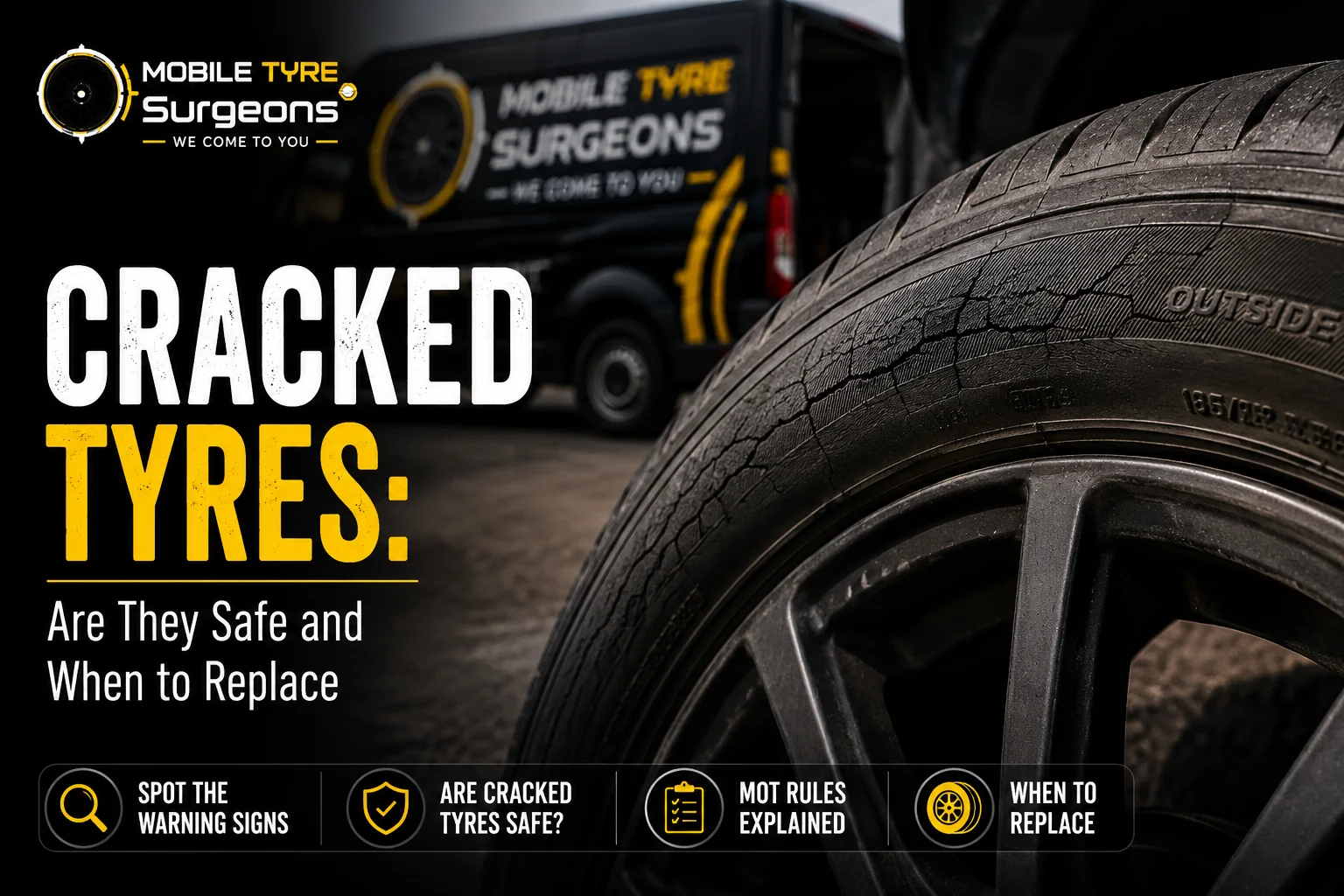
The mildest version is fine surface crazing, a web of shallow lines across the rubber. It looks alarming. Often it is just the top layer of rubber reacting to sunlight and age, with healthy structure underneath. Edge cracking runs along the outer edge of the tread and tends to point at underinflation or hard cornering. The one that should make you stop is sidewall cracking, the deeper lines or splits on the flat face of the tyre between the rim and the tread.
Sidewall cracks matter more than tread cracks for a simple reason. The sidewall flexes most, with every bump, every corner, every braking effort. A crack there is a weak point in the component working hardest, and the RAC notes that while cracked tyres are not automatically illegal, they are genuinely dangerous to you and everyone around you.
Are cracked tyres safe to drive on?
It depends entirely on depth, and that is the honest answer rather than a hedge. A tyre with light surface crazing and good tread can be perfectly safe and perfectly legal. The crazing is the rubber telling you it is ageing, not that it has failed.
Deep cracking is a different conversation. Once a crack runs past the surface rubber, the tyre’s structural integrity is compromised, and under heat, load and motorway speeds those cracks expand fast. That is when a blowout stops being unlikely and starts being a question of when. A blowout at 70mph on the M25 is not a situation anyone wants to learn about firsthand. If you have already had one, our guide on what to do after a tyre blowout before calling mobile puncture repair walks through the immediate steps.
The practical test is whether you can see into the crack. If light cracks are barely visible and shallow, monitor them. If you can see depth, see the crack opening when you press the rubber, or see anything resembling cords or fabric, the tyre is done. Drive gently to somewhere safe and arrange a replacement.
Cracked tyres and the MOT
Cracking is not on the list of things that are illegal in the way bald tread is. The legal tread minimum in the UK is 1.6mm across the central three-quarters of the tyre, around the full circumference, and that line is absolute. Cracking is judged differently. It falls under tyre condition, and the MOT tester makes a call on whether the damage is serious enough to be unsafe.
Goodyear’s MOT guidance is clear that sidewall damage such as a lump, bulge or tear from structural failure can fail the test, while small cuts that do not reach the carcass may only earn an advisory. Cracking works the same way. Light crazing might pass with an advisory note. Deep cracking, or any crack exposing the cords or ply underneath, is a straightforward failure regardless of tread.
This is worth sitting with for a second. You could have a tyre with 5mm of tread, looking healthy from above, that still fails its MOT because the sidewall has perished. Tread depth and tyre condition are two separate checks, and a tyre has to pass both.
One call and a fitter comes to the car
Home, work, roadside or car park, anywhere in London and across the UK. Tyres on board and balancing done on site.
20 to 30 min ETA in LondonCars, vans and luxury vehiclesOpen 24/7, seven days
Why tyres crack in the first place
Most cracking comes down to a handful of causes, and several have nothing to do with mileage.
Age is the big one. Rubber degrades whether you drive on the tyre or not, which is why a low-mileage car that sits outside can have cracked tyres while a high-mileage commuter car does not. Sunlight accelerates it. UV light and ozone both attack the rubber compound, so a car parked on an exposed driveway in full sun ages its tyres faster than one kept in a garage.
Underinflation plays a role too. A soft tyre flexes more than it should, the sidewall works harder, and the extra heat speeds up cracking. One more reason to keep pressures correct, and our tyre pressure guide covers the right figures for your vehicle. Long periods parked up cause their own problem, because a stationary tyre carries the car’s full weight on one patch of rubber for weeks. Harsh cleaning products and solvent-based tyre dressings can strip the protective waxes as well, a quietly common own goal.
When to replace a cracked tyre
Here is the part that actually decides things. Use crack depth, tyre age and location together rather than relying on any single factor.
|
What you can see |
Likely meaning |
Action |
| Fine surface crazing, very shallow | Cosmetic surface ageing | Monitor, recheck at every service |
| Cracks visible with some depth | Rubber perishing into the structure | Get inspected soon, plan replacement |
| Deep sidewall cracks or splits | Compromised structural integrity | Replace, do not drive far |
| Any crack exposing cords or fabric | Tyre failure imminent | Replace immediately |
| Cracking plus tyre age over 10 years | Rubber well past its service life | Replace regardless of tread |
Age is the cleanest hard line. Continental, Michelin and other manufacturers, along with the AA, advise treating 10 years from the manufacture date as the absolute maximum for any tyre, with closer inspection from around 5 years. You can read the age straight off the sidewall in the DOT code, where the last four digits give the week and year of manufacture, so “2319” means the 23rd week of 2019. If your tyre is cracking and the DOT code is a decade old, there is no decision left to make.
One thing worth being firm about: a cracked tyre cannot be repaired. Puncture repairs under BS AU 159 cover small holes in the tread area of an otherwise sound tyre. Cracking is the rubber itself breaking down, and no plug or patch fixes that. If you want to understand which damage actually is repairable, our breakdown of what tyre punctures can be repaired sets out the limits.
If your tyre needs replacing, our mobile tyre replacement service comes to your home, work or roadside.
How to check your own tyres for cracking
You do not need tools for this, just a few minutes and decent light. Once a month is plenty, and before any long trip.
Walk round the car and look at the sidewall of each tyre, then crouch and check the inner sidewall too, because cracking often hides on the side you cannot see from standing. Press a thumb gently into any crack you find. If it opens up or shows depth, note it. Run your eye along the tread grooves for cracking between the blocks. Do the same for the spare if you carry one, since a spare ages exactly like a fitted tyre while doing nothing in the boot.
If you spot anything beyond light surface crazing, get a professional opinion rather than guessing. A trained eye can tell perished rubber from harmless crazing in seconds, and the safety charity TyreSafe is a solid source for current UK guidance on tyre condition. When a tyre does need changing, mobile tyre fitting means the work happens at your home or workplace instead of you driving a questionable tyre to a garage. For a tyre that has already cracked badly or split, emergency tyre fitting is the safer route than risking the drive.
A final word
Cracked tyres sit in an awkward middle ground, and that is exactly why they get ignored. They are not illegal the way bald tread is, the car drives fine, and the cracks creep in slowly enough that you stop noticing them. That gradual quality is the trap.
My rule after years of fitting tyres is simple. If a crack makes me hesitate, it has already answered the question. Surface crazing on a four-year-old tyre is fine. A web of cracks on a tyre with a ten-year-old date stamp is not something to nurse through one more winter. Tyres are the only thing connecting two tonnes of car to the road, and rubber that has started to split is rubber you cannot fully trust. Give yours a proper look this month, check the spare while you are at it, and let the depth of the cracks make the decision for you.
If you are in London, our mobile tyre fitting London team can come to you, usually within 20 to 30 minutes, and replace a cracked tyre at your home or workplace.
One call and a fitter comes to the car
Home, work, roadside or car park, anywhere in London and across the UK. Tyres on board and balancing done on site.
20 to 30 min ETA in LondonCars, vans and luxury vehiclesOpen 24/7, seven days